






Dr. Raj Krishna Mondal

Data Scientist

About

AI Researcher | Data Scientist | Mathematician

I am a Data Scientist, AI Researcher, and Mathematician specializing in Artificial Intelligence, Generative AI, Natural Language Processing (NLP), Large Language Models (LLMs), and Prompt Engineering, with a Ph.D. in Mathematics and Scientific Computing, I focus on designing AI-powered solutions that drive automation, decision-making, and intelligent information systems.

Currently, I am leading the development of an AI-powered cognitive search engine, integrating large language models (LLMs), agent-based AI, and NLP to transform data interaction. My work focuses on algorithm design, AI-driven automation, and intelligent decision-making systems to enhance business intelligence, healthcare analytics, and advanced computing.

Beyond research and development, I am actively involved in academia, mentoring AI enthusiasts, contributing to AI-driven publications, and sharing my knowledge through conferences and workshops. Let's connect and explore the future of AI together!

Areas of Interest

Data Science Machine Learning Deep Learning Generative AI Agentic AI Natural Language Processing Prompt Engineering Big Data Soft Computing Qualitative Research Fuzzy Set Theory Complex Decision Making

Education

My academic journey reflects a strong foundation in Mathematics and Scientific Computing, leading to advanced research in Computational Mathematics.

Secondary Education

Secondary Education

School: Mijalapur Birindra Vidyapith

Board: West Bengal Board of Secondary Education

Year: 2007

Marks: 79.75%

Higher Secondary Education

Higher Secondary Education

School: Contai Model Institution

Board: West Bengal Council of Higher Secondary Education

Year: 2009

Marks: 79.40%

Bachelor of Science

Bachelor of Science (B.Sc.)

College: Surendranath College

University: University of Calcutta

Year: 2014

Specialization: Mathematics Honours

Marks: 61.25%

Master of Science

Master of Science (M.Sc.)

Institute: Motilal Nehru National Institute of Technology (MNNIT), Allahabad

Year: 2016

Specialization: Mathematics and Scientific Computing

CGPA: 7.62/10

4th Semester Project Title: On Perspectives and Application of Fuzzy Initial Value Problems

Abstract

On this project, we discussed fuzzy differential equations and fuzzy initial value problems. It introduces fuzzy sets and fuzzy differential equations as extensions of classical set theory and differential equations to account for uncertainty. Several examples of fuzzy initial value problems are analyzed, comparing their behaviors under different types of differentiability. The solutions exhibit very different properties, even though the original crisp equations were equivalent, showing that different fuzzy representations can model the same real-world problem very differently.

Ph.D. in Computational Mathematics

Ph.D. in Computational Mathematics

Institute: Motilal Nehru National Institute of Technology (MNNIT), Allahabad

Year: 2022

CGPA: 7.67/10

Thesis: A study on Design and Development of Soft Computing Diagnostic Information System in Medical Science

Abstract

The complexity and uncertainty in medical diagnosis necessitate the development of intelligent systems capable of handling imprecise, vague, and ambiguous data. This research focuses on the design and development of a Soft Computing-based Diagnostic Information System to enhance decision-making in medical science. Utilizing fuzzy logic, hesitant fuzzy sets, and computing with words, the study addresses challenges in diagnosing diabetes, assessing kidney function, and ranking qualitative medical conditions. A novel Hesitant Fuzzy Envelope-based Expert System is introduced to model human decision-making under uncertainty. Additionally, a QUALIFLEX-based ranking approach is implemented to prioritize medical conditions efficiently. The research further explores a Diet Recommendation System incorporating soft computing techniques to provide personalized dietary suggestions. The findings contribute to the advancement of medical diagnostic systems, improving accuracy and decision support in healthcare.

Objectives

Secondary Education

To uphold integrity in my work and secure a role in industry or research where I can effectively leverage my expertise in Intelligence, Generative AI, Natural Language Processing, and Data Science

I aim to

  • Expand my knowledge and stay updated with the latest advancements in AI and Data Science.
  • Contribute meaningfully to innovative projects that solve real-world problems.
  • Work collaboratively in a dynamic environment that fosters creativity and critical thinking.
  • Utilize my technical skills to drive efficiency, automation, and smarter decision-making.
  • Engage in continuous learning and professional development to enhance my expertise.

Technical Skills

Expert in AI, Data Science, Software Development, and Prompt Engineering.

Operating Platforms

Windows 99%
Linux 90%
MacOS 95%

Programming Languages

Python 95%
C 85%
C++ 80%
R 80%
SQL 87%

Prompt Engineering

LangChain 90%
LangGraph 85%
CrewAI 80%
AutoGen 75%

Tools

Scikit-Learn, Numpy, Pandas 95%
Seaborn, Plotly, Matplotlib 90%
TensorFlow, Keras, PyTorch 90%
PySpark, Spacy, NLTK 80%

Software

Tableau, Power BI, Excel 90%
MATLAB 95%
Mathematica 80%
GeoGebra 90%
Maple 70%

Database/Server

MySQL 85%
MongoDB 85%
Neo4j 75%

Research & Achievements

Dr. Rajkrishna Mondal has made significant contributions in AI, Soft Computing, and Mathematical Modeling, with publications, certifications, and active participation in international conferences and workshops.

Research Papers Published in reputed journals

Conference Papers Presented at international conferences

AI Research Projects Published on GitHub

Best Paper Award ICRTIMR-2020

Professional Certifications Deep Learning, NLP, AI

Workshops Attended AI, Big Data, Cryptology

Conferences Attended Global AI & Data Science

Organized Conferences FAI International Events

Publications

Our research harnesses advanced fuzzy logic and computational intelligence to solve complex decision-making challenges in healthcare, engineering, and data analytics. We develop innovative models—such as fuzzy utility matrices, interval-valued hesitant fuzzy sets, and hybrid intelligent systems—to improve diagnostics, optimize diet recommendations for metabolic disorders, and enhance multi-criteria decision-making.

Our findings are widely disseminated through leading international journals, and we actively share our work at global conferences and specialized workshops. These events provide a platform for collaboration, knowledge exchange, and real-world application of our research.

Publication Reference
PUBLICATIONS
PAPER PRESENTED IN CONFERENCES
2022

Fuzzy Utility Matrix-Based Intelligent Decision-Making Model and Its Application to Diet Recommendation System for Metabolic Disorder Patients

Rajkrishna Mondal and Pankaj Srivastava

International Journal of Fuzzy System Applications (IJFSA)

Vol. 11(1) (pp. 1-22), IGI Global

Abstract

In the present article an effort has been made to design and develop a diet recommendation system for metabolic disorder patients. The key feature of this system is to recommend a dinner menu that maintains the required nutritional micros based on the patient’s personal information, physical activity, environment, and food habits. The system is structured in phases—from calculating calorie requirements to developing a knowledge base and finally designing the recommendation system. Validation using the Degree of Match algorithm and expert feedback confirms its utility in assisting both urban and rural populations.

2021

Design and Development of Intelligent Information System Using Hesitant Fuzzy Weighting Linguistic Term Sets for Computing with Words

Pankaj Srivastava and Rajkrishna Mondal

Mathematical, Computational Intelligence and Engineering Approaches for Tourism, Agriculture and Healthcare (LNNS, Volume 214)

Lecture Notes in Networks and Systems, pp. 195–207, Springer

Abstract

This paper presents an intelligent information system developed on the basis of Hesitant Fuzzy Weighting Linguistic Term Sets for computing with words. The system addresses the inherent impreciseness and hesitation in decision-making by providing a structured approach to scaling and weighting linguistic criteria, thereby enabling more accurate conclusions in complex decision scenarios.

2021

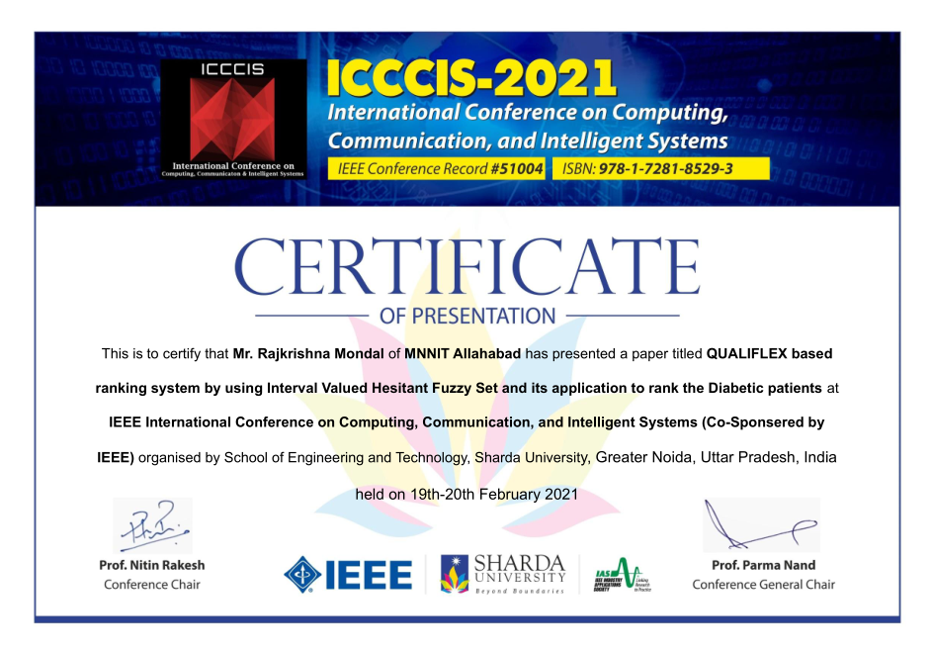
QUALIFLEX based ranking system by using Interval Valued Hesitant Fuzzy Set and its application to rank the Diabetic patients

Pankaj Srivastava and Rajkrishna Mondal

2021 International Conference on Computing, Communication, and Intelligent Systems (ICCCIS 2021)

(pp. 78-85), IEEE

Abstract

This study introduces a ranking system based on QUALIFLEX methodology which utilizes Interval Valued Hesitant Fuzzy Sets for evaluating and ranking diabetic patients. The approach aggregates uncertain evaluations into a fuzzy utility matrix, providing an effective tool for clinical decision support in diabetes care.

2021

Design and Development of an Intelligent System to Assess Kidney Performances of Persons Suffering from Diabetes

Pankaj Srivastava and Rajkrishna Mondal

International Transaction Journal of Engineering, Management, and Applied Sciences and Technologies

Vol. 12(4) (pp. 12A4A:1-14), TuEngr Group

Abstract

The paper outlines an intelligent system for assessing kidney performance in diabetic patients. Utilizing fuzzy logic techniques, the system integrates various clinical parameters to provide a comprehensive evaluation of kidney function. Its performance is validated through expert assessments and statistical analysis, proving its potential in clinical diagnostics.

2021

A Hesitant Fuzzy Envelope Based Expert System in Human Decision Making

Pankaj Srivastava and Rajkrishna Mondal

Nepal Journal of Mathematical Sciences

Vol. 2(1) (pp. 1-6), ISSN: 2738-9928

Abstract

This work presents an expert system employing a Hesitant Fuzzy Envelope approach to capture the inherent uncertainty and hesitation in human decision-making. By outputting an envelope of potential outcomes rather than a single crisp result, the system offers a more nuanced and realistic representation of group decision-making processes.

2020

Diabetes Diagnostic Intelligent Information System

Pankaj Srivastava and Rajkrishna Mondal

TEST Engineering and Management

Vol. 82: Jan/Feb 2020 (pp. 14455-4467), The Mattingley Publishing Co., Inc

Abstract

This article describes a diagnostic system for diabetes that integrates fuzzy logic with intelligent algorithms to evaluate patient data. The system effectively calculates diagnostic parameters and offers a reliable alternative to traditional diagnostic methods, as verified by statistical tests and expert review.

2019

A Medical Diagnostic Information System with Computing with Words Using Hesitant Fuzzy Sets

Rajkrishna Mondal, Akshay Verma and Pushpendra Kumar Gupta

Advances in VLSI, Communication, and Signal Processing

(pp. 971–980), Springer

Abstract

This chapter introduces a medical diagnostic system that utilizes the computing with words paradigm via Hesitant Fuzzy Sets. The system transforms qualitative medical judgments into computational data, facilitating more effective diagnostic decision-making. Comparative analyses demonstrate its improved performance over traditional methods.

2018

Neural based energy-efficient stable clustering for multilevel heterogeneous WSNs

Akshay Verma, Rajkrishna Mondal, Prateek Gupta and Arvind Kumar

2018 First International Conference on Secure Cyber Computing and Communication (ICSCCC)

(pp. 208-212), IEEE

Abstract

This paper proposes a neural network based algorithm for clustering in multilevel heterogeneous Wireless Sensor Networks. Focusing on energy efficiency and network stability, the algorithm integrates fuzzy logic with neural computation to improve clustering performance. Simulation results confirm significant improvements over conventional methods.

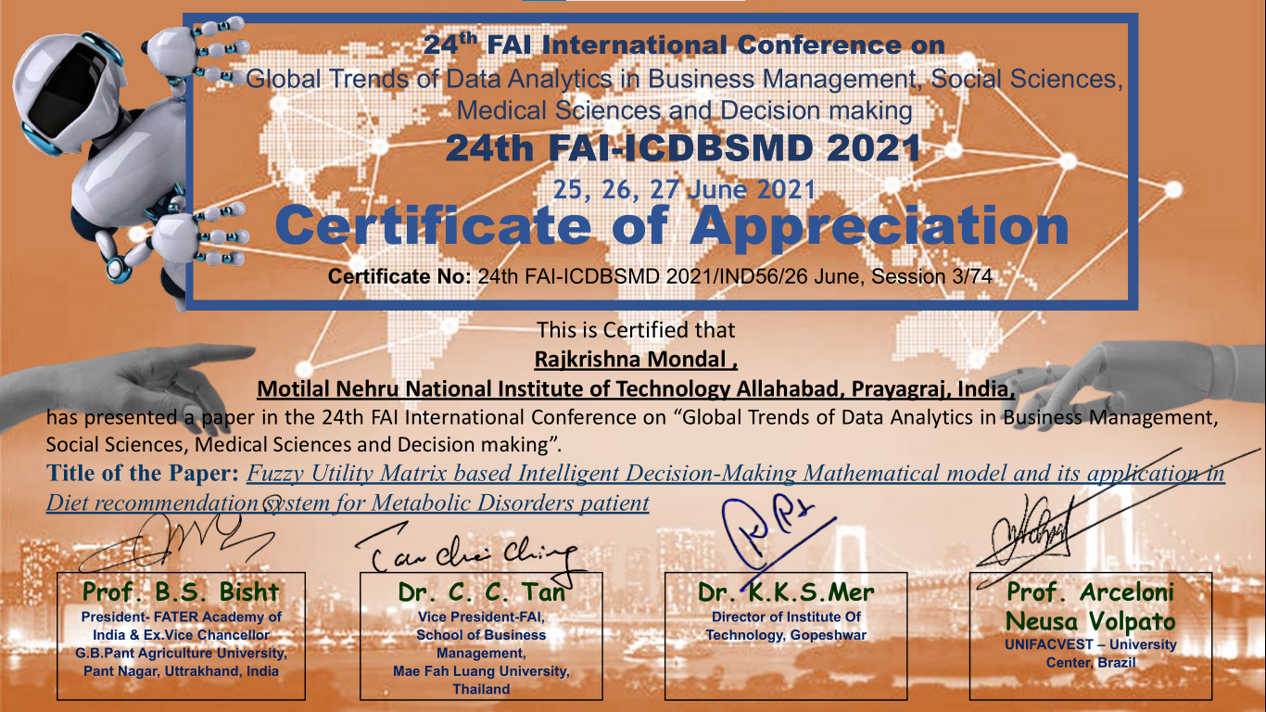
25-27 Jun, 2021

24th FAI International Conference on Global Trends of Data Analytics in Business Management, Social Sciences, Medical Sciences and Decision making (24th FAI-ICDBSMD 2021)

Presented paper Title: Fuzzy Utility Matrix based Intelligent Decision-Making Mathematical model and its application in Diet recommendation system for Metabolic Disorders patient

Organized by FATER Academy of India; Institute of Technology, Gopeshwar and UNIFACVEST – University Center, Brazil

19-20 Feb, 2021

International Conference on Computing, Communication, and Intelligent Systems (ICCCIS-2021)

Presented paper Title: QUALIFLEX based ranking system by using Interval Valued Hesitant Fuzzy Set and its application to rank the Diabetic patients

Organized by Sharda University, Greater Noida, India

IEEE Conference Record 51004; ISBN No.: 978-1-7281-8529-3

14 Mar, 2020

International Conference on Recent Trends and Innovations in Multidisciplinary Research (ICRTIMR-2020)

Presented paper Title: Diabetes Diagnostic Intelligent Information System

Organized by IEC University, Baddi, H.P., India

Jointly organized by Globally Multidisciplinary Research and Education Association (GMREA)

21-23 Dec, 2019

International Conference on Engineering, Mathematical and Computational Intelligence (ICEMCI-2019)

Presented paper Title: Design and Development of Intelligent Information System using Hesitant Fuzzy Weighting Linguistic Term Sets for Computing with Words

Organized by Jabalpur Engineering College, Jabalpur, Madhya Pradesh, India in association with FATER Academy of India and Walchand Engineering College, Sangli, Maharashtra, India

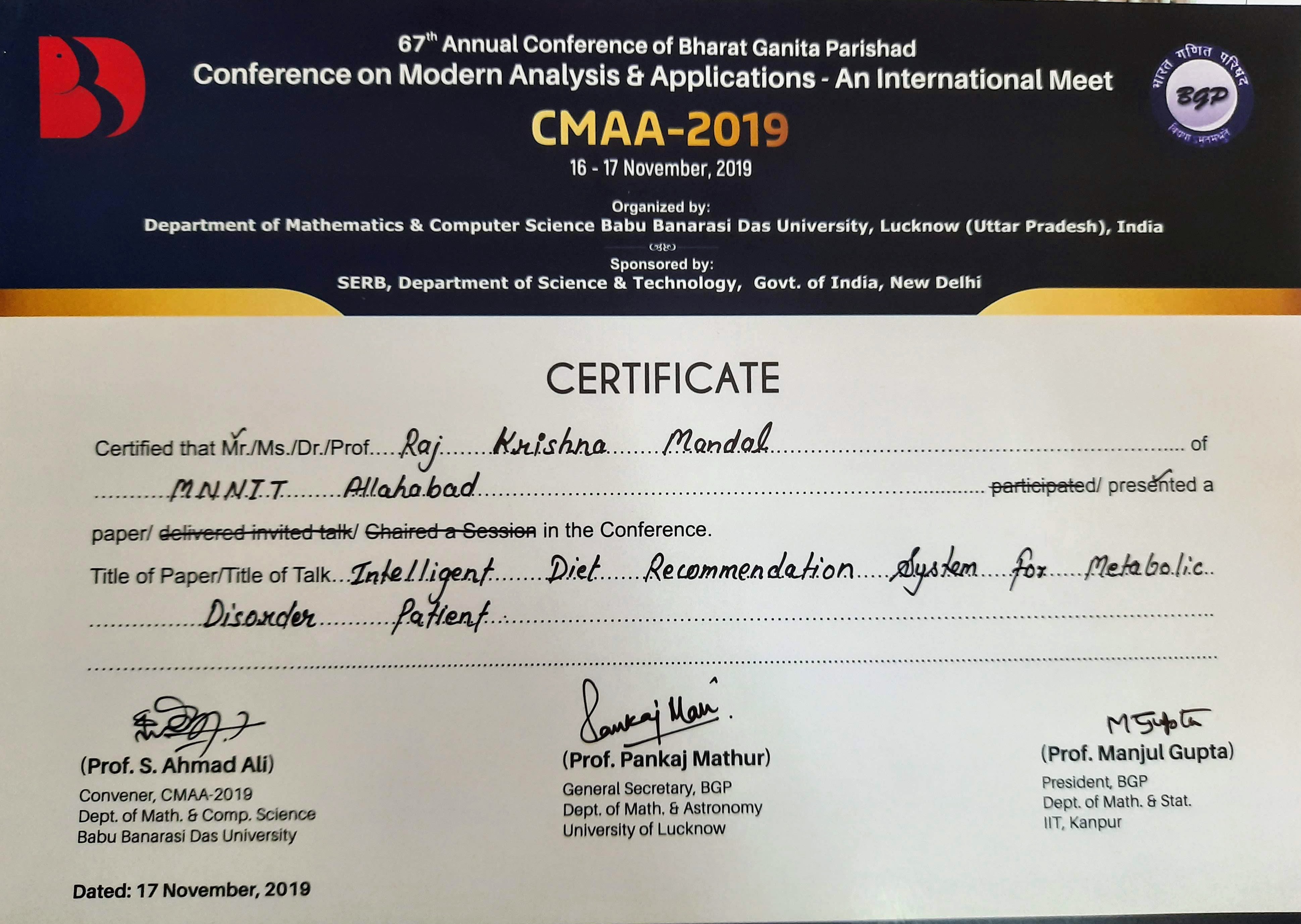
16-17 Nov, 2019

Conference on Modern Analysis and Applications – An International Meet (CMAA-2019) (67th Annual Conference of Bharat Ganita Parishad)

Presented paper Title: Intelligent Diet Recommendation System for Metabolic Disorders Patient

Organized by The Department of Mathematics and Computer Science, Babu Banarasi Das University, Lucknow (Uttar Pradesh), India in collaboration with Bharat Ganita Parishad, Lucknow, India

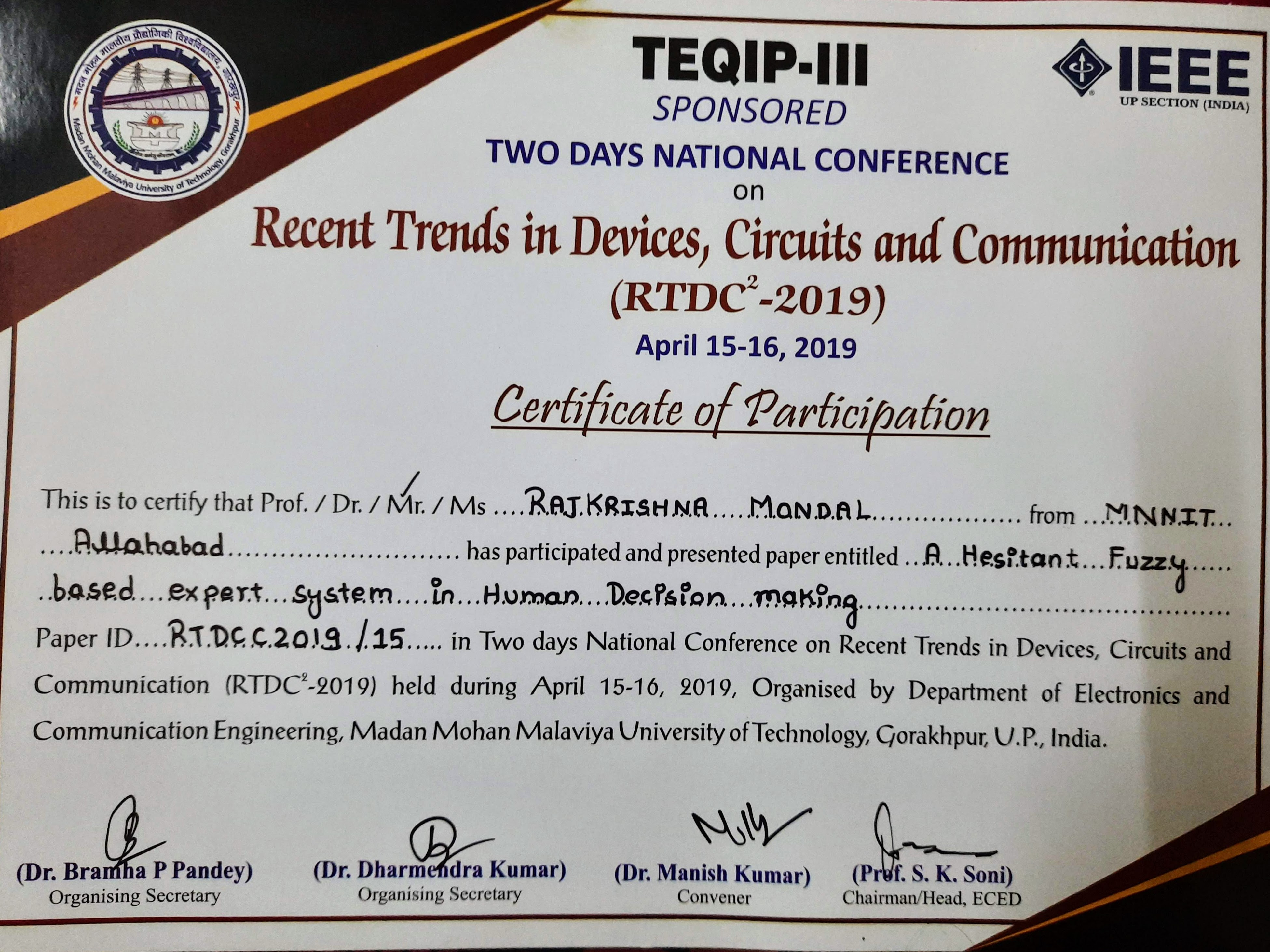
15-16 Apr, 2019

National Conference on Recent Trends in Devices, Circuits and Communication (RTDC2-2019)

Presented paper Title: A Hesitant Fuzzy based expert system in Human Decision making

Organized by Department of Electronics and Communication Engineering, Madan Mohan Malaviya University of Technology, Gorakhpur, UP, India

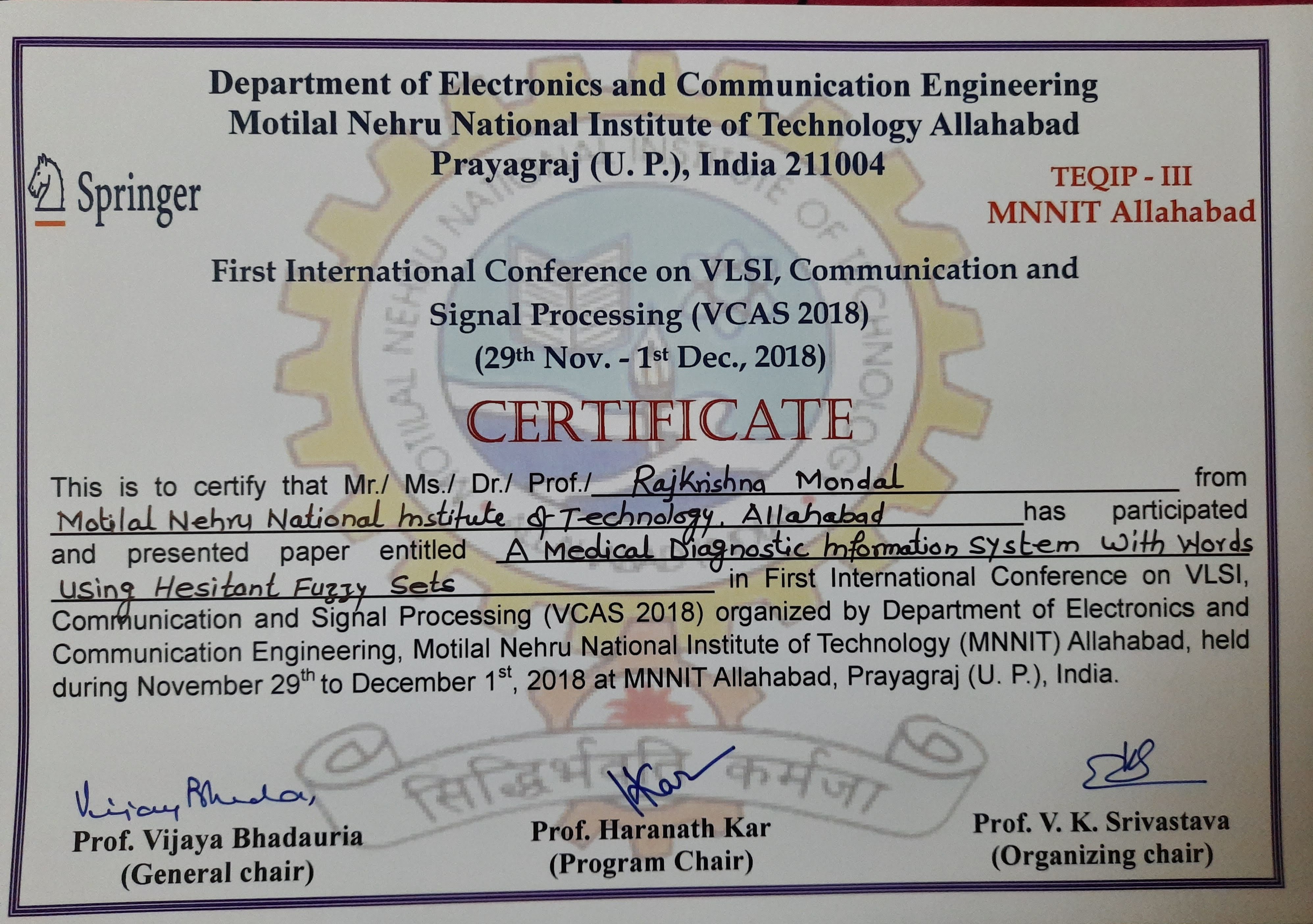
29 Nov-1 Dec, 2018

International Conference on VLSI, Communication and Signal Processing (VCAS 2018)

Presented paper Title: A Medical diagnostic information system with Computing with Words using Hesitant Fuzzy Sets

Organized by ECE Department, MNNIT Allahabad, Prayagraj, India

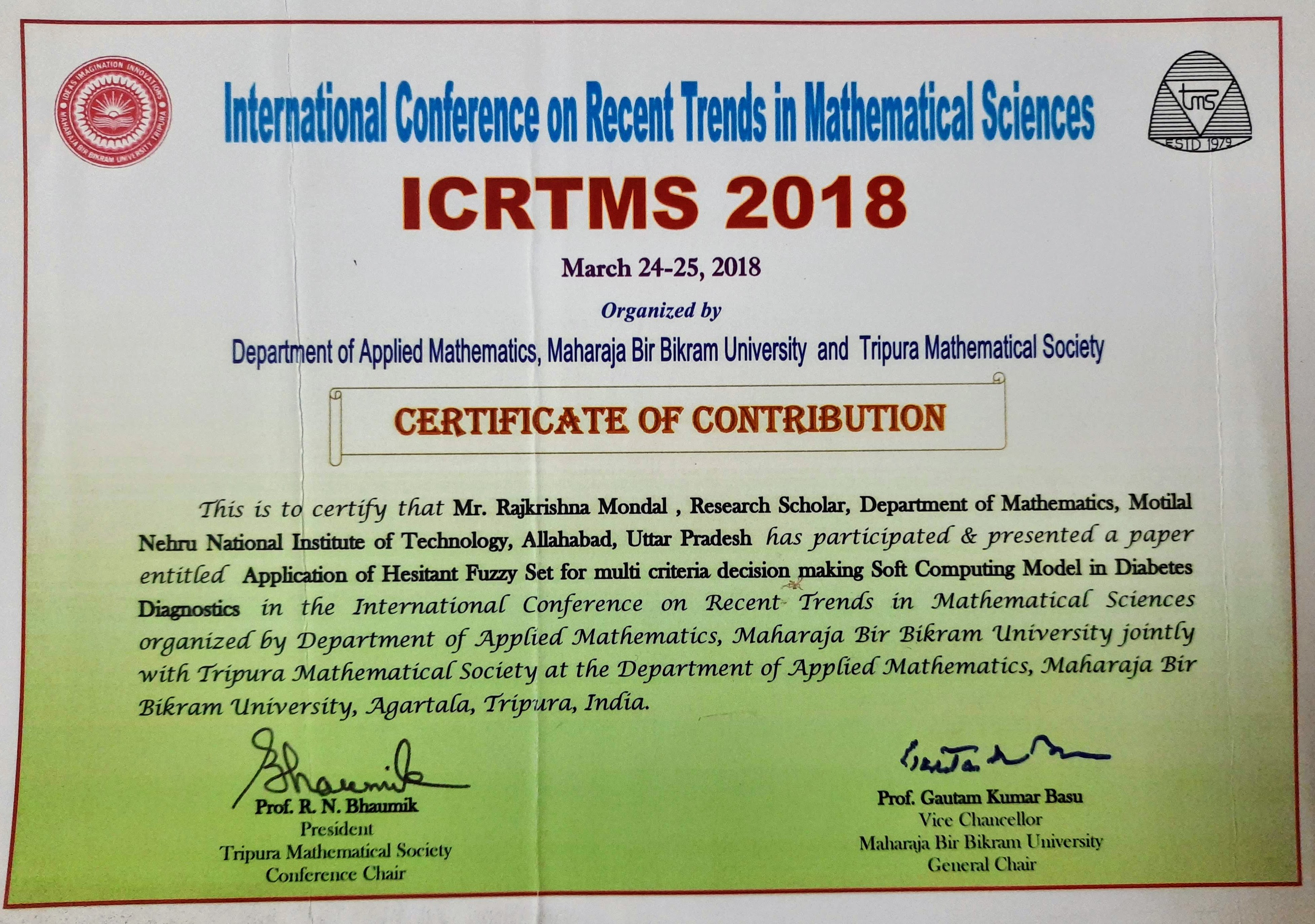
24-25 Mar, 2018

International Conference on Recent Trends in Mathematical Sciences (ICRTMS-2018)

Presented paper Title: Application of Hesitant Fuzzy Set for multi-criteria decision making Soft Computing Model in Diabetes Diagnostics

Organized by Department of Applied Mathematics, Maharaja Bir Bikram Univesity, Tripura, India in collaboration with Tripura Mathematical Society, Tripura, India
27-28 May, 2021

II International Scientific Internet Conference on ACTUAL PROBLEMS OF PHYSICAL CULTURE, SPORTS AND HEALTH

Jointly organized by The Bohdan Khmelnytsky National University of Cherkasy

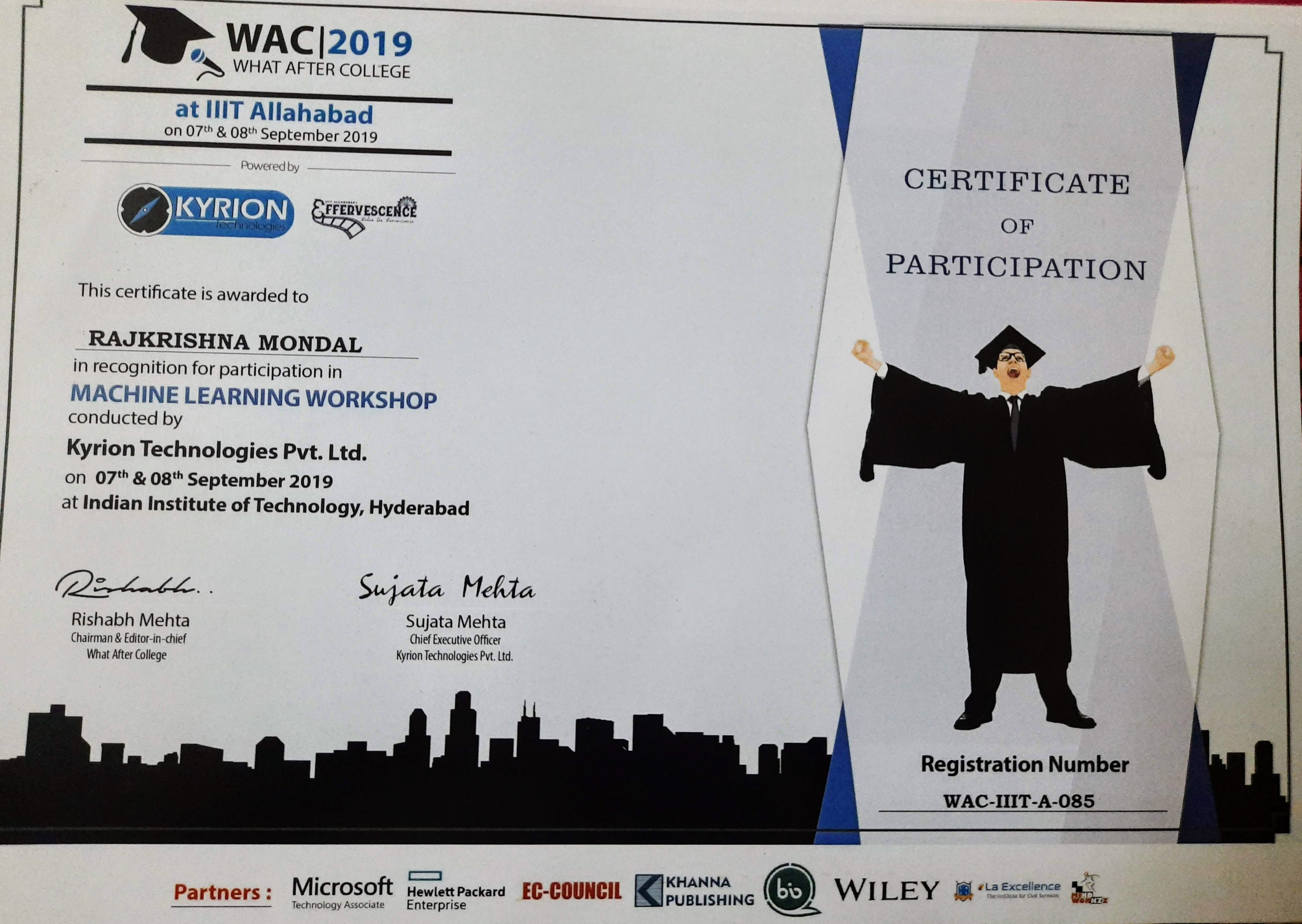
07-08 Sept, 2019

Machine Learning Workshop

Organized by Kyrion Technologies Pvt. Ltd. at IIIT Allahabad

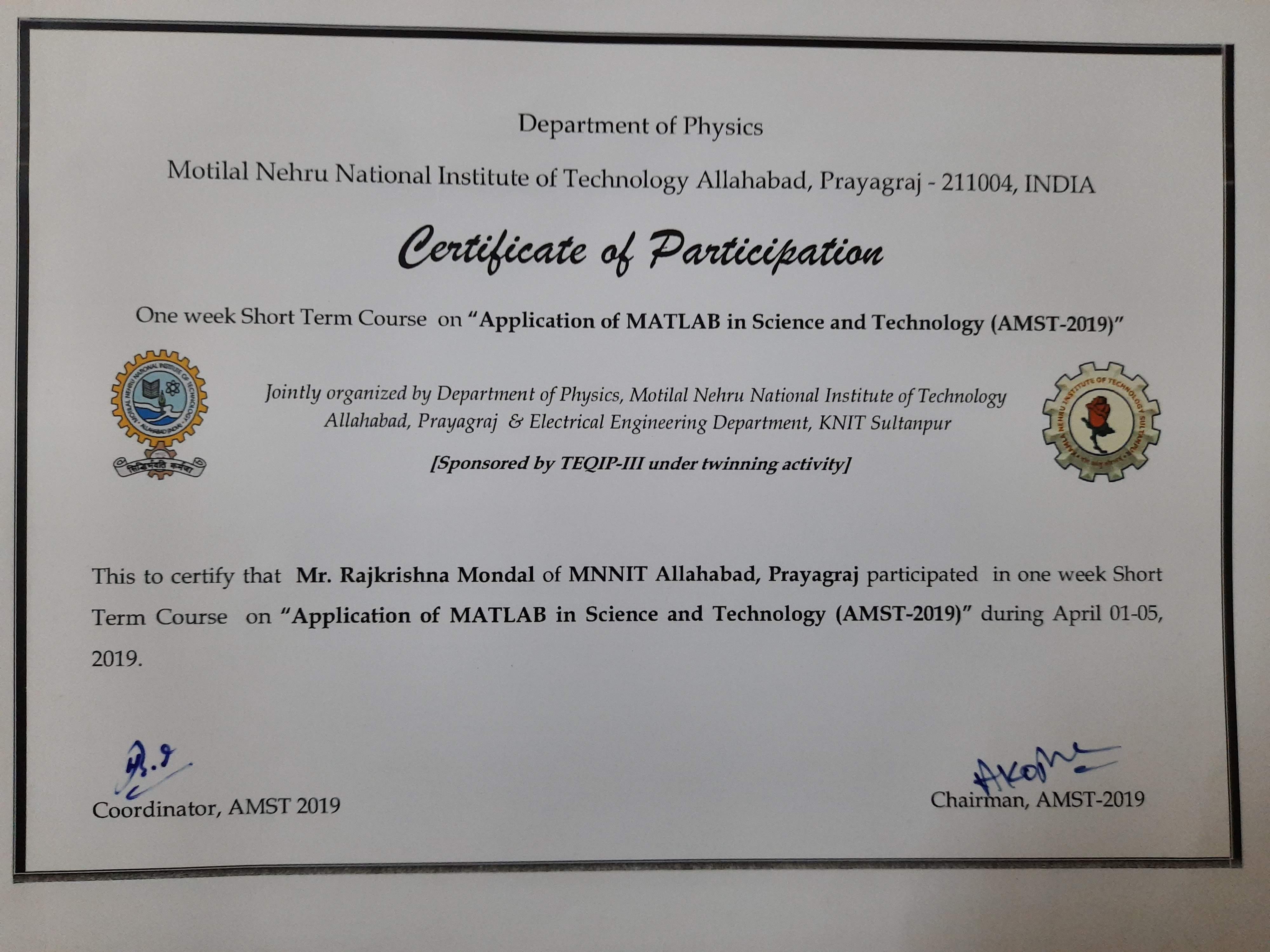
01-05 Apr, 2019

Application of MATLAB in Science and Technology (AMST -2019)

Jointly organized by Department of Physics, MNNIT Allahabad, Prayagraj, India and Electrical Engineering Department, KNIT Sultanpur, Uttar Pradesh, India

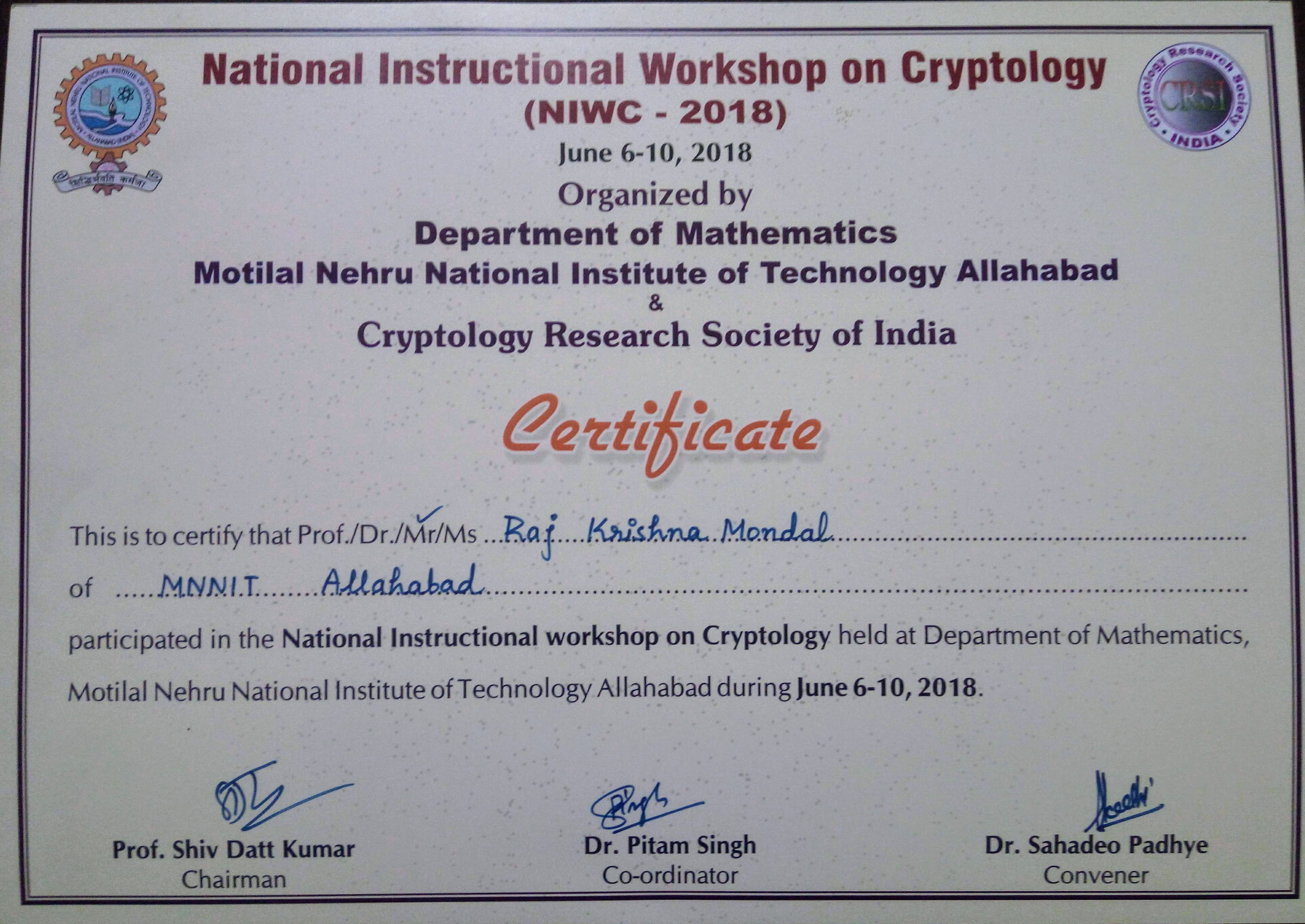
6-10 Jun, 2018

National Instructional Workshop on Cryptology

Organized by Department of Mathematics, MNNIT Allahabad in collaboration with Cryptology Research Society of India

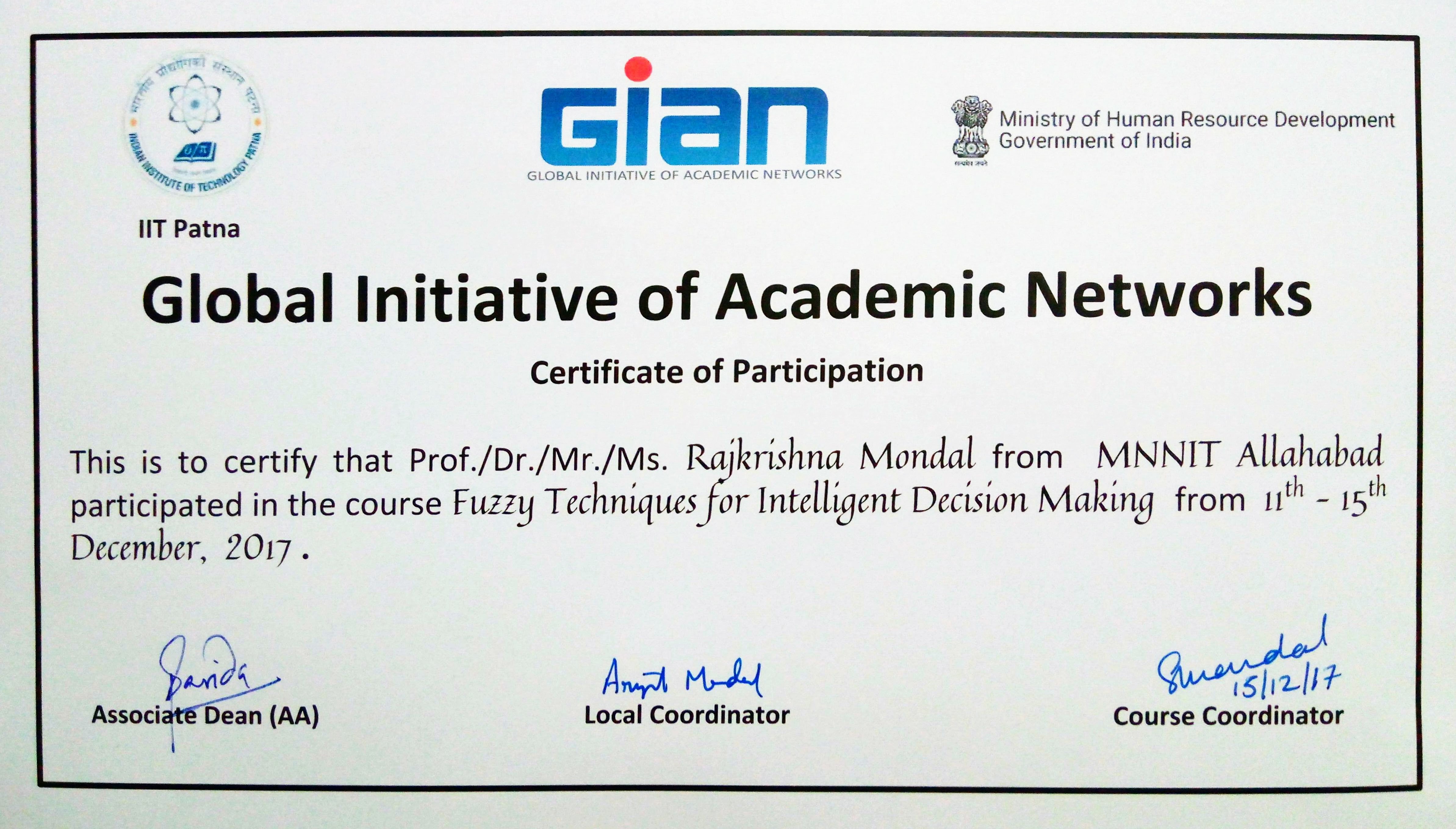
11-15 Dec, 2017

Fuzzy Techniques for Intelligent Decision Making

Organized by IIT Patna in collaboration with Global Initiative of Academic Networks (GIAN)

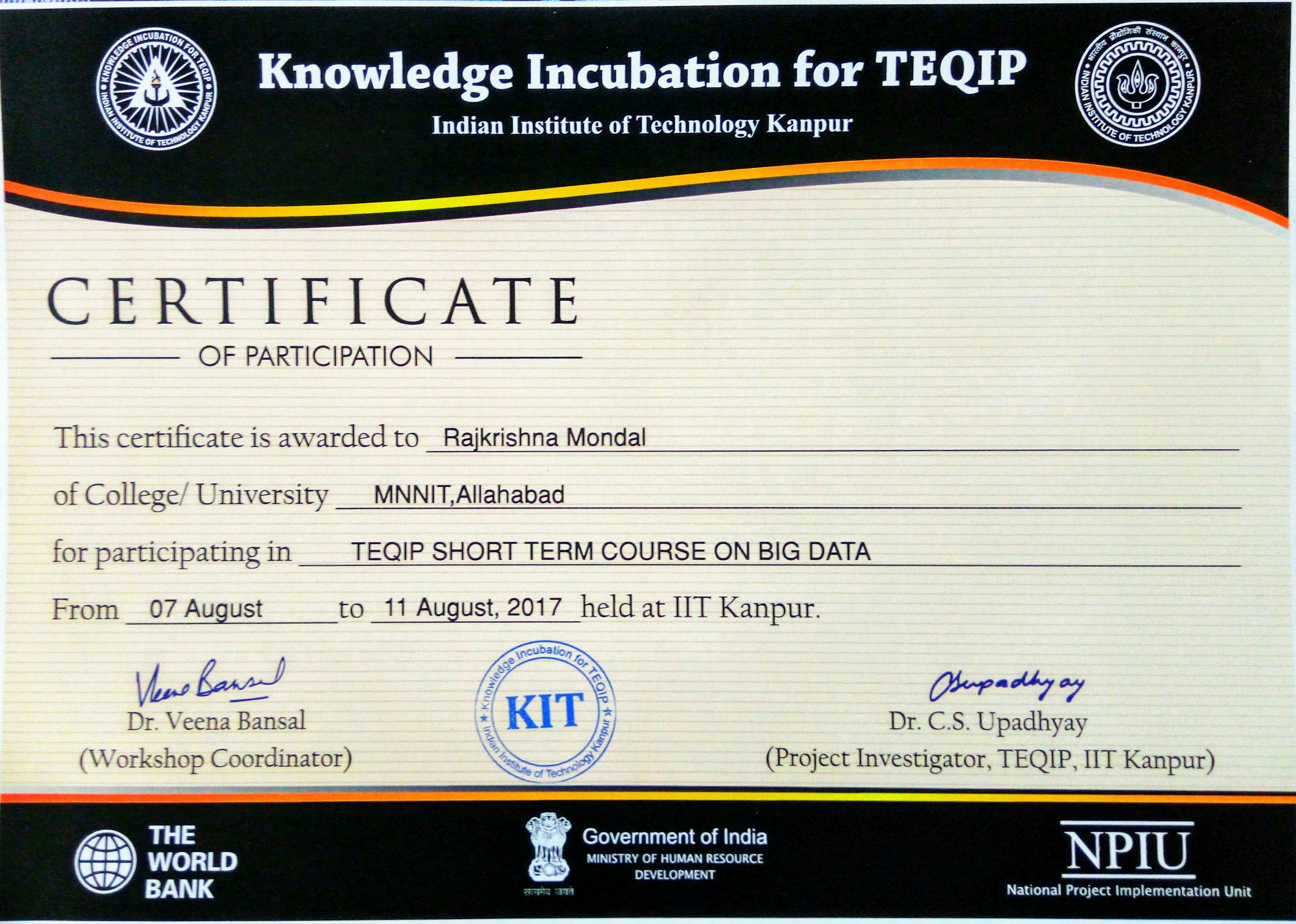
7-11 Aug, 2017

Big Data

Organized by IIT Kanpur in collaboration with Knowledge Incubation for TEQIP

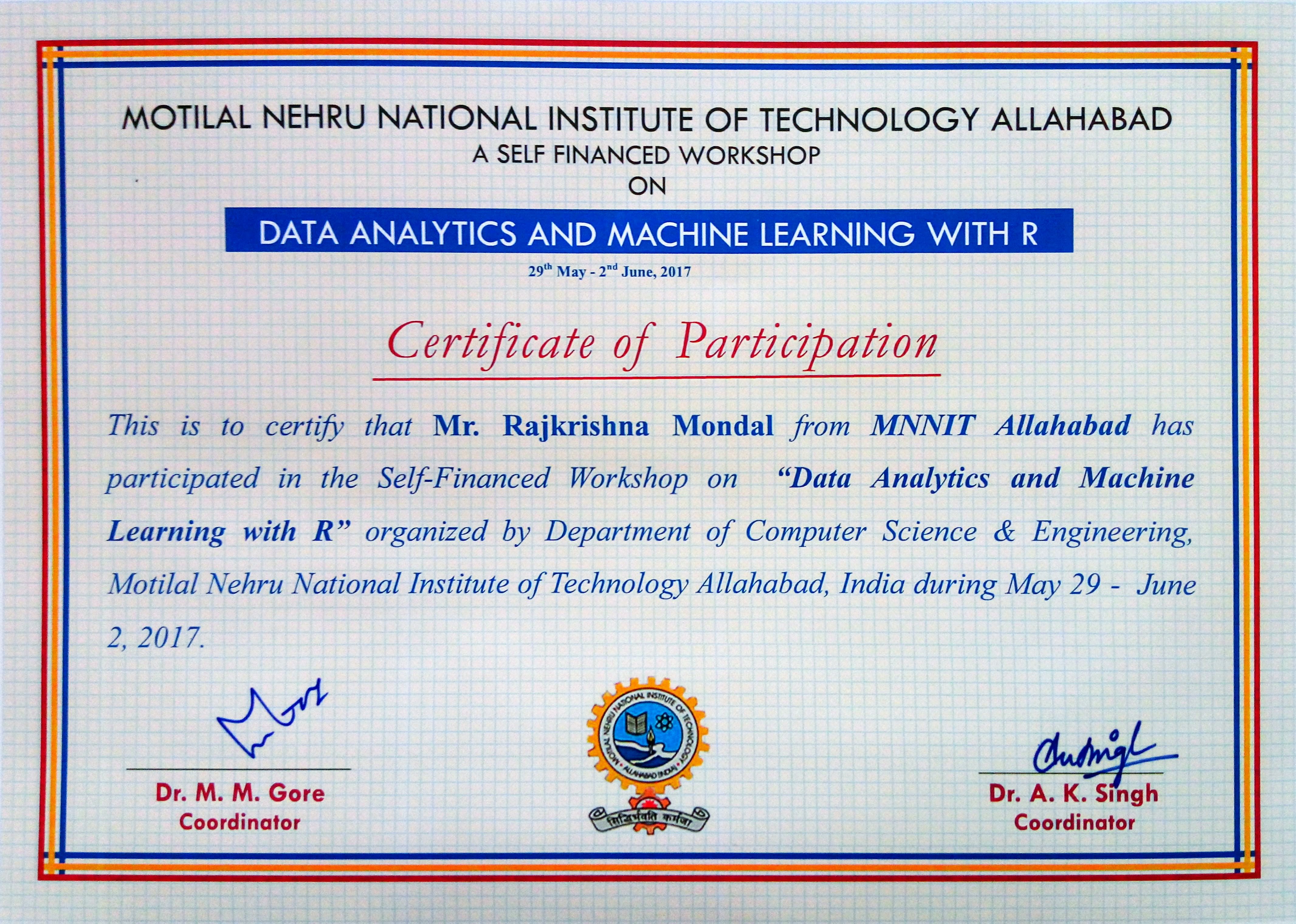
29 May -2 Jun, 2017

Data Analytics and Machine Learning with R (DAMLR-17)

Organized by the Department of Computer Science and Engineering, MNNIT Allahabad, Prayagraj, India

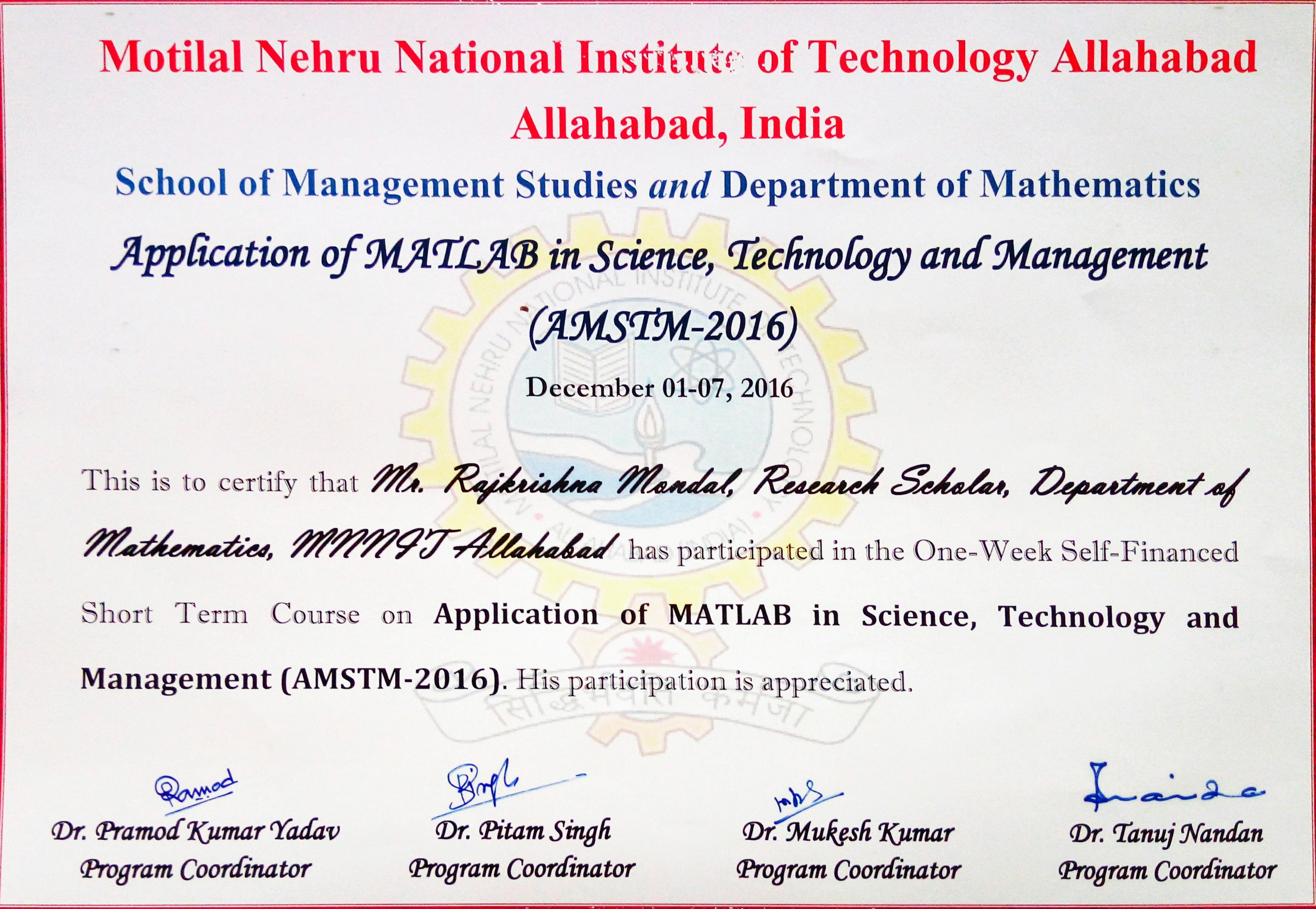
1-7 Dec, 2016

Application of MATLAB in Science, Technology and Management (AMSTM-2016)

Organized by School of Management studies and Dapartment of Mathematics, MNNIT Allahabad, Prayagraj, India

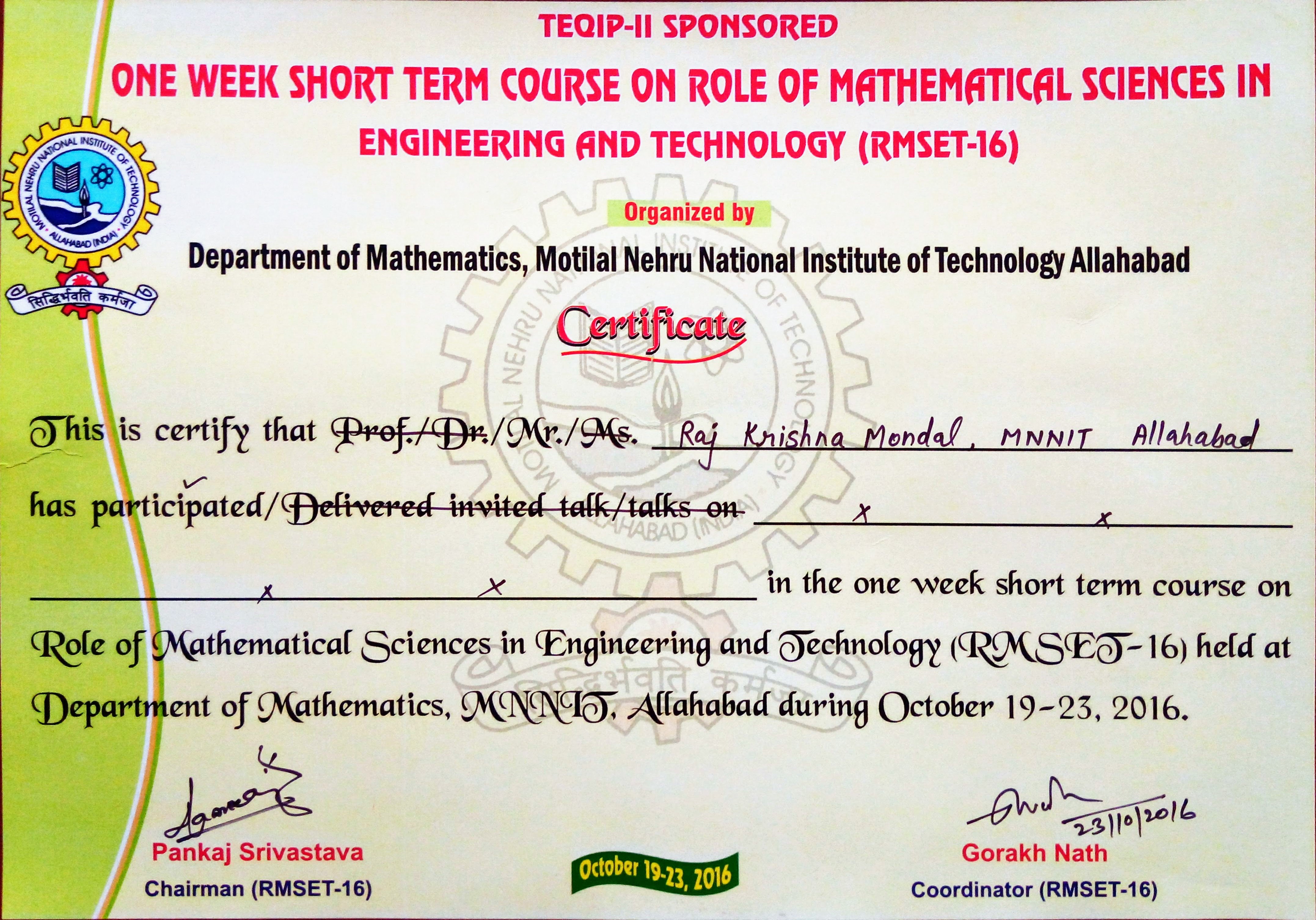
19-23 Oct, 2016

Role of Mathematical Sciences in Engineering and Technology (RMSET-16)

Organized by Department of Mathematics, MNNIT Allahabad, Prayagraj, India

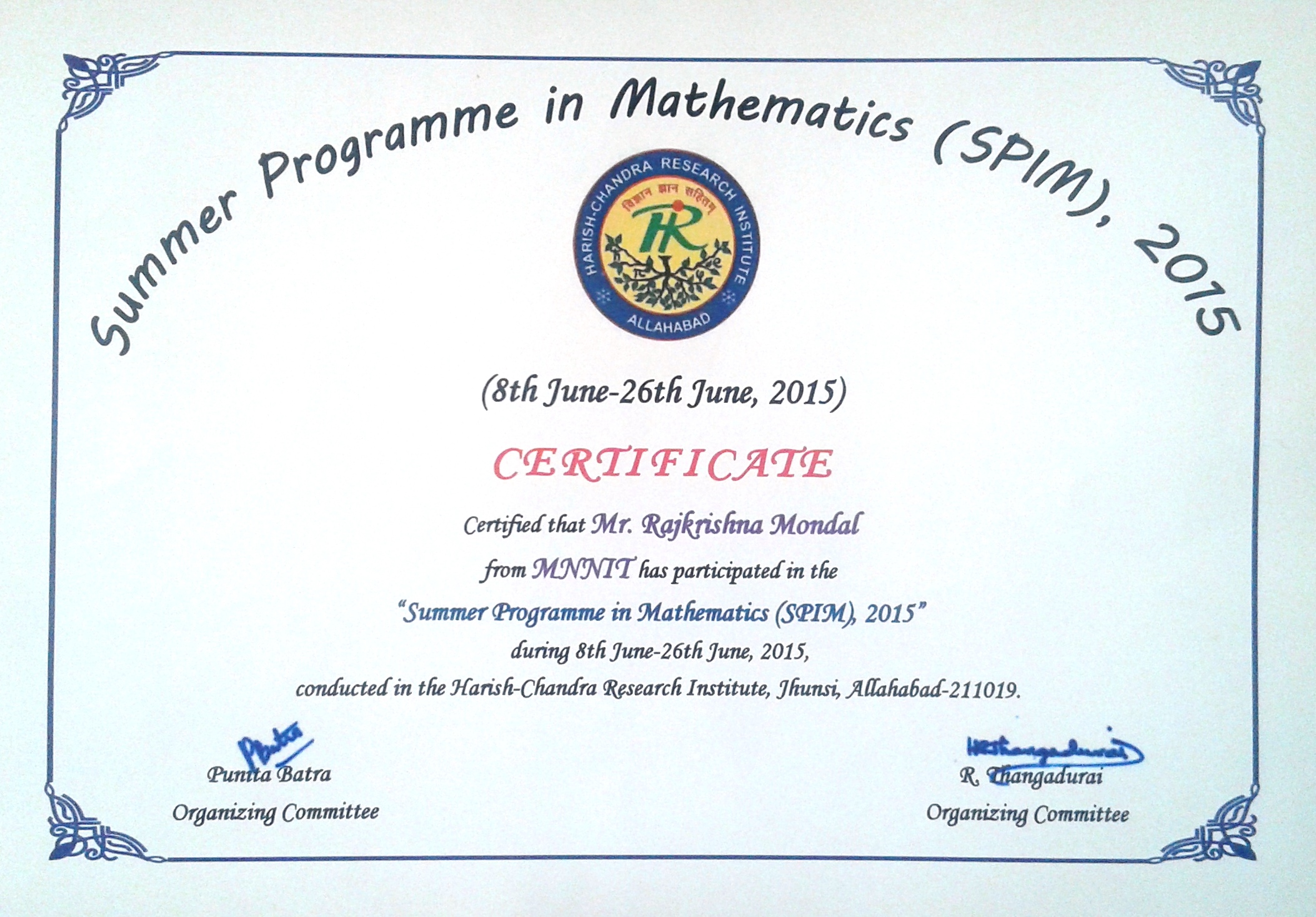
8-26 Jun, 2015

Summer Program in Mathematics (SPIM 2015)

Organized by Harish-Chandra Research Institute, Prayagraj, India

Attended Conferences and Workshops

The various conferences and workshops I have attended, where I have had the opportunity to present research, participate in discussions, and gain hands-on experience in emerging technologies. Conferences have allowed me to engage with experts, explore the latest advancements, and contribute to knowledge-sharing in fields like artificial intelligence, data science, and cybersecurity. Meanwhile, workshops have provided immersive, practical learning experiences, enhancing my skills in areas such as cloud computing, cybersecurity, and machine learning. Together, these experiences have broadened my understanding and strengthened my expertise, fostering continuous learning and professional growth.

  • All
  • Conferences
  • Workshops

24th FAI-ICDBSMD 2021

25-27 June, 2021

ICCCIS-2021

19-20 February, 2021

CMAA -2019

16-17 Nov, 2019

RTDC2-2019

15-16 Apr, 2019

VCAS 2018

29 Nov-1 Dec, 2018

ICRTMS-2018

24-25 Mar, 2018

ACTUAL PROBLEMS OF PHYSICAL CULTURE, SPORTS AND HEALTH

27-28 May, 2021

MACHINE LEARNING WORKSHOP

7-8 Sept, 2019

AMST-2019

1-5 April, 2019

National Instructional Workshop on Cryptology 2018

6-10 Jun, 2018

Fuzzy Techniques for Intelligent Decision Making

11-15 Dec, 2017

Big Data

7-11 Aug, 2017

Data Analytics and Machine Learning with R (DAMLR-17)

29 May -2 Jun, 2017

Application of MATLAB in Science, Technology and Management (AMSTM-2016)

1-7 Dec, 2016

Role of Mathematical Sciences in Engineering and Technology (RMSET-16)

19-23 Oct, 2016

Summer Program in Mathematics (SPIM)

8-26 Jun, 2015

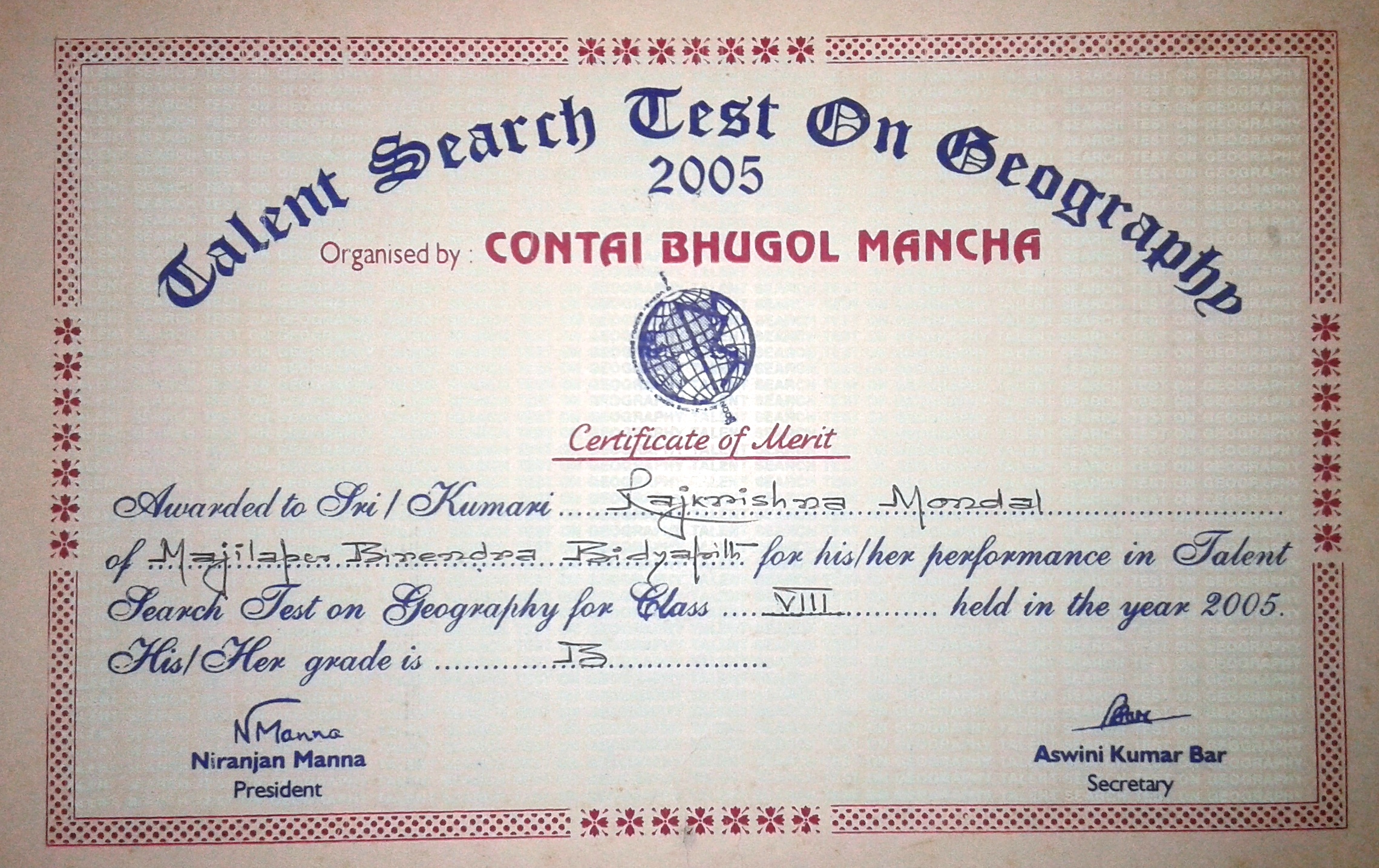
Talent Search Test on Geography

2005

LICENSES & CERTIFICATIONS

Certified in SQL, Machine Learning, Deep Learning, and Generative AI from platforms like Coursera and Udemy. Specialized in NLP, Big Data, and AI with expertise in LangChain, LLMs, and agentic AI. Holds multiple advanced certifications in deep learning, sequence models, and big data from institutions like DeepLearning.AI and IBM.

  • All
  • Deep Learning
  • NLP
  • LLM
  • Big Data

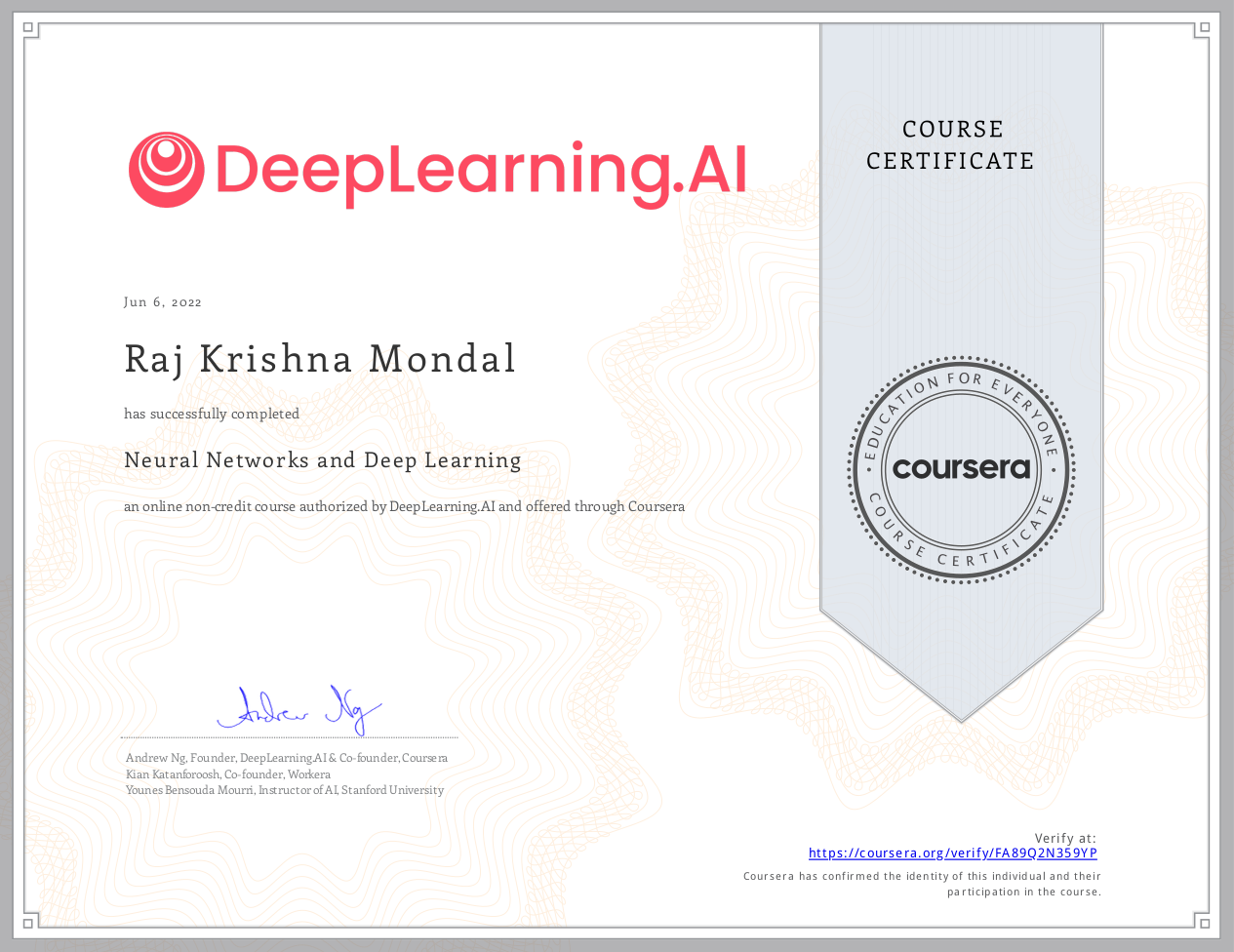
Neural Networks and Deep Learning

June 6, 2022

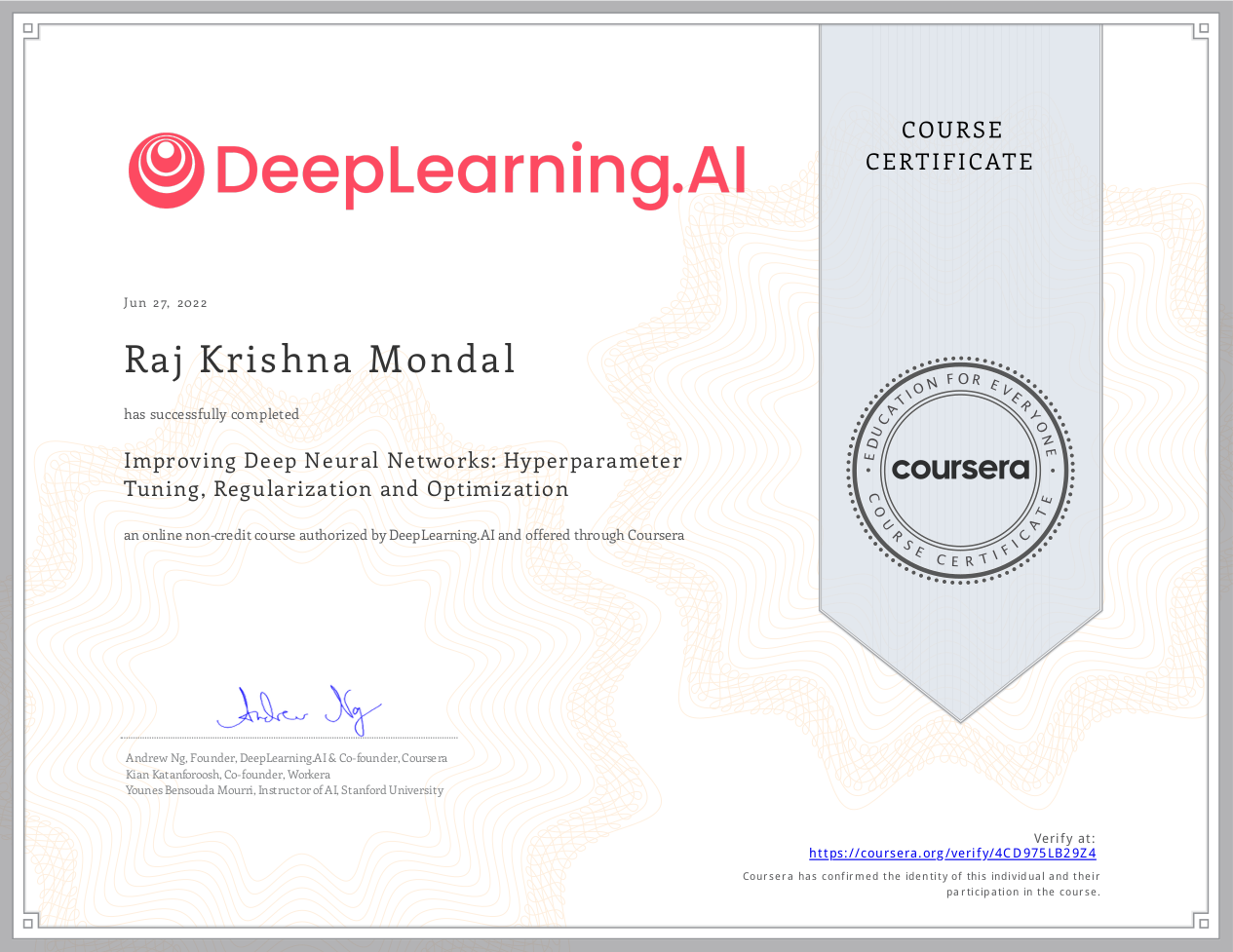
Improving Deep Neural Networks: Hyperparameter Tuning, Regularization and Optimization

June 27, 2022

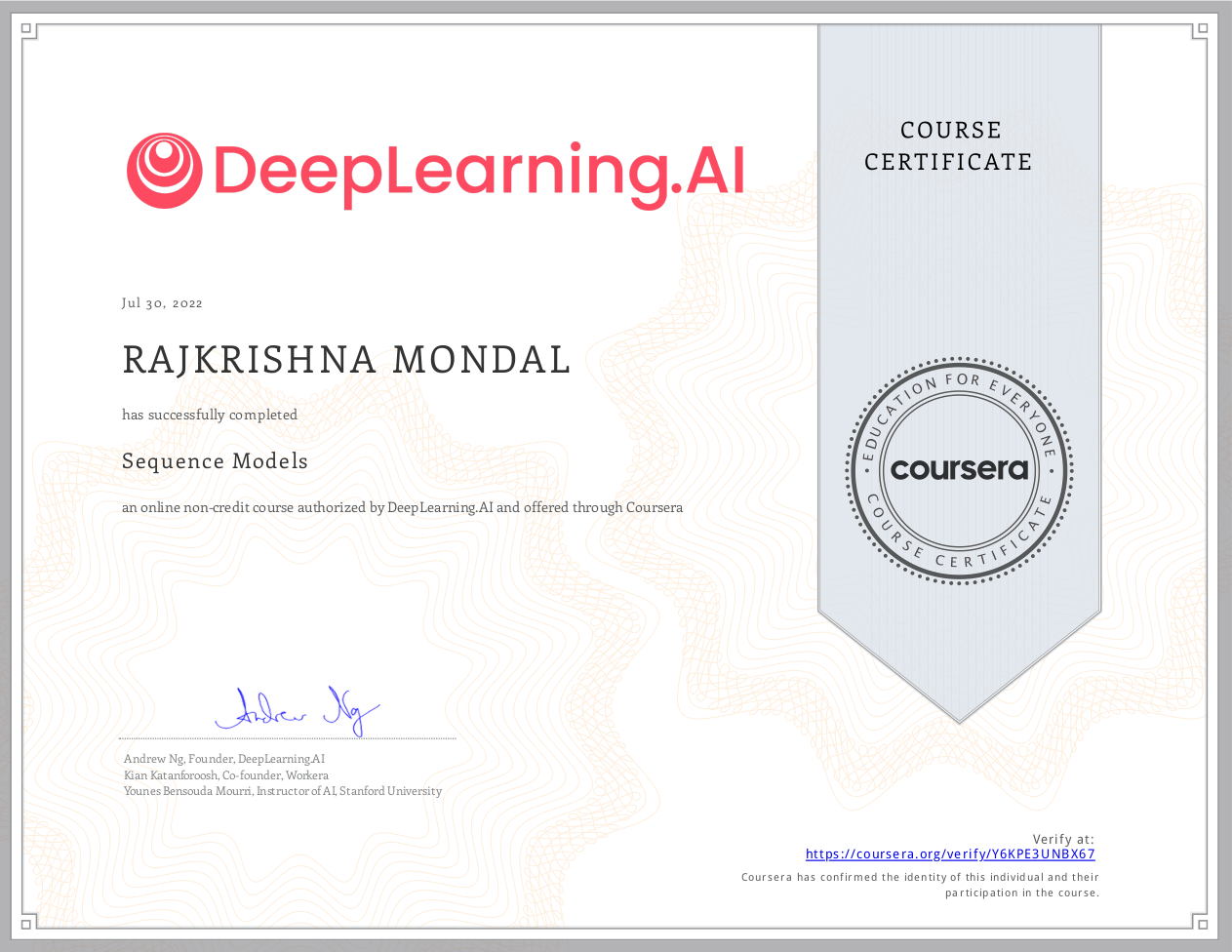
Sequence Models

July 30, 2022

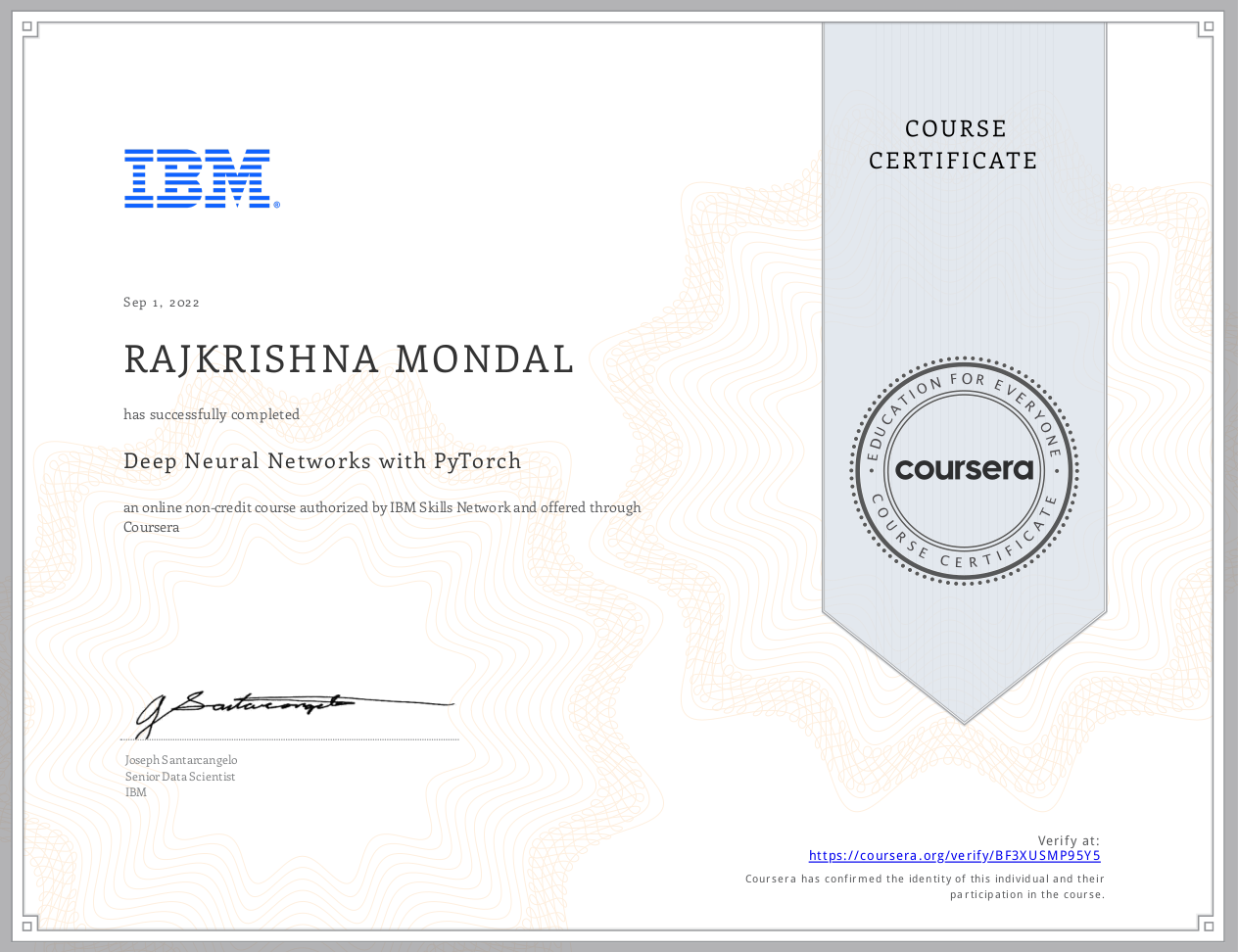
Deep Neural Networks with PyTorch

September 1, 2022

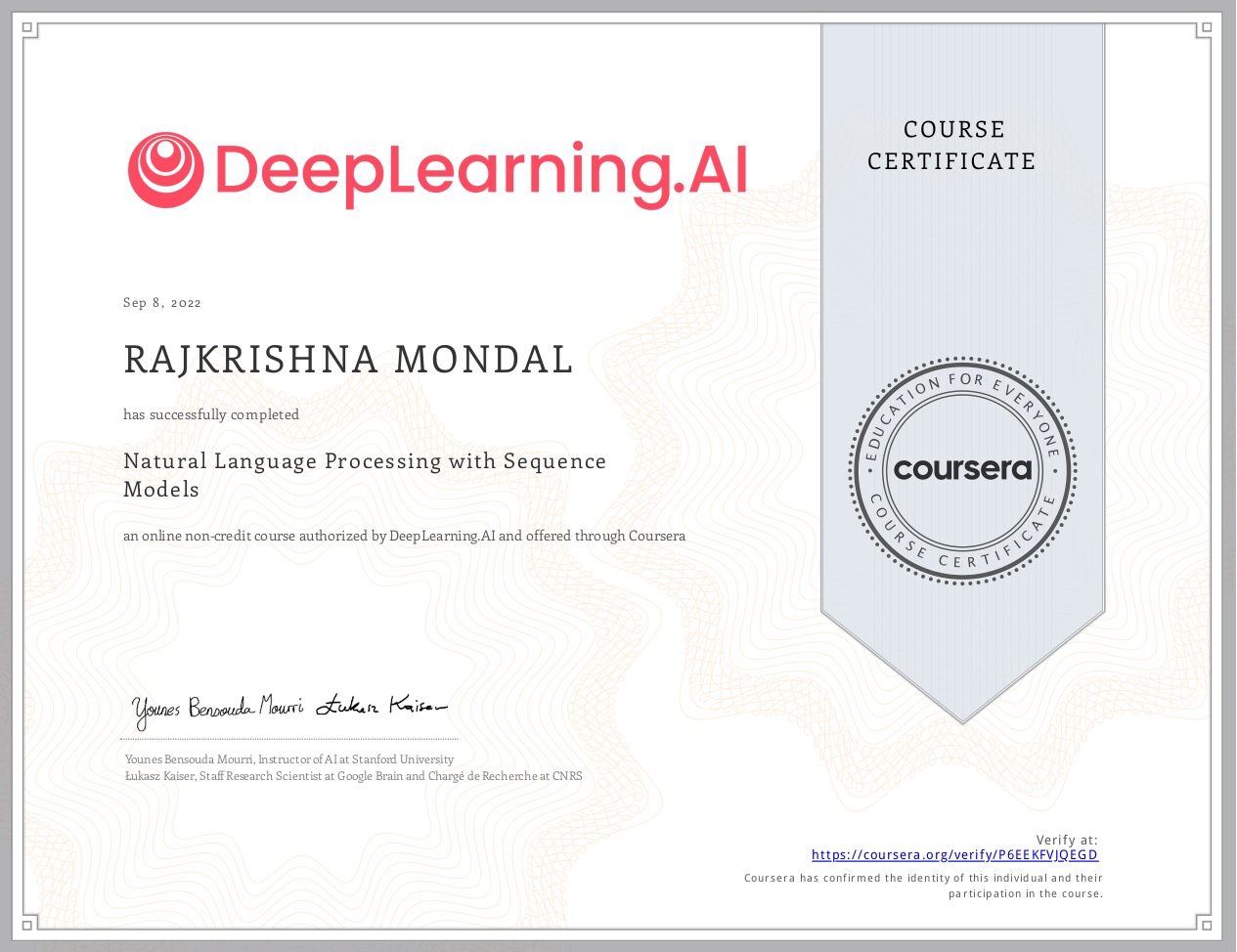
Natural Language Processing with Sequence Models

September 8, 2022

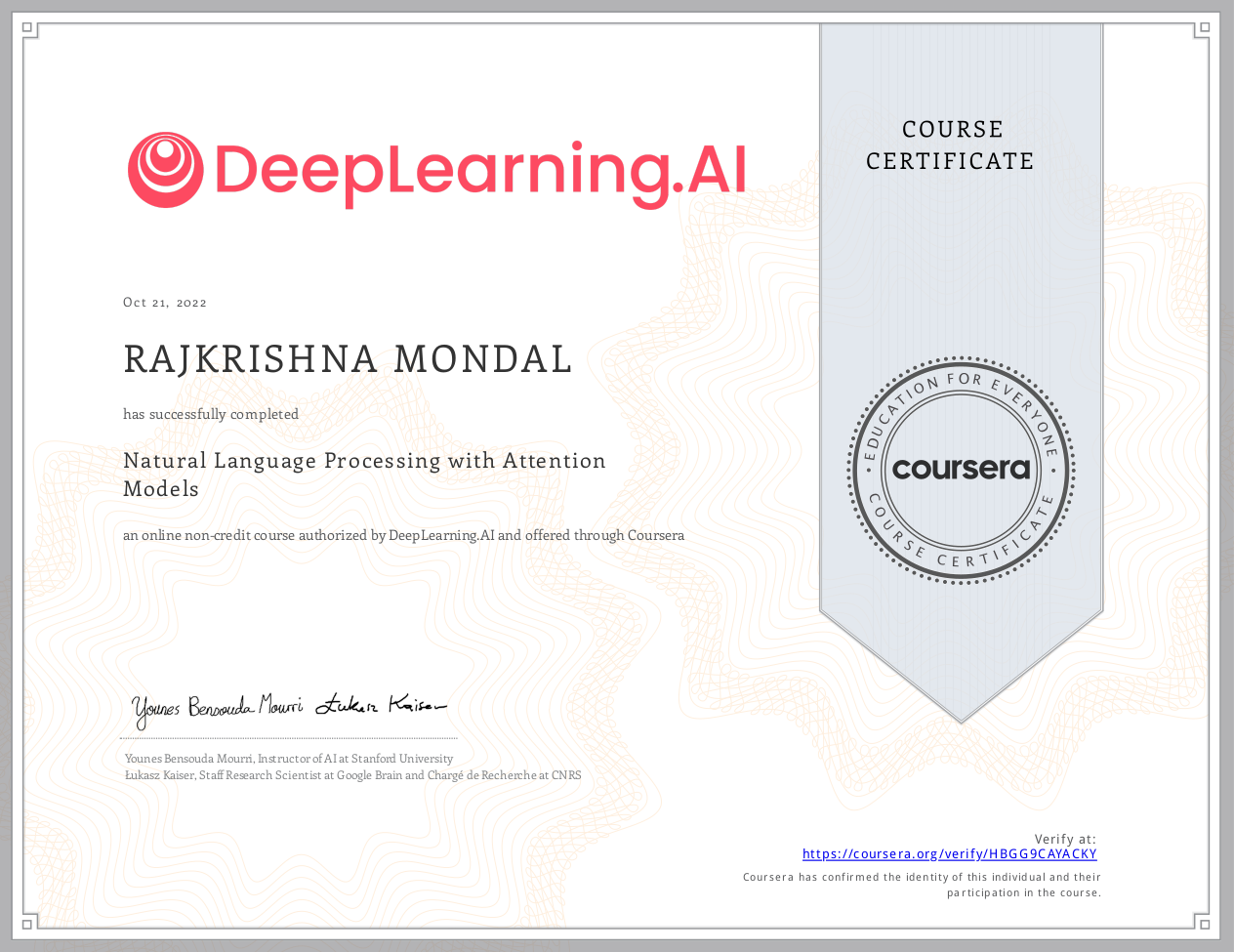
Natural Language Processing with Attention Models

October 21, 2022

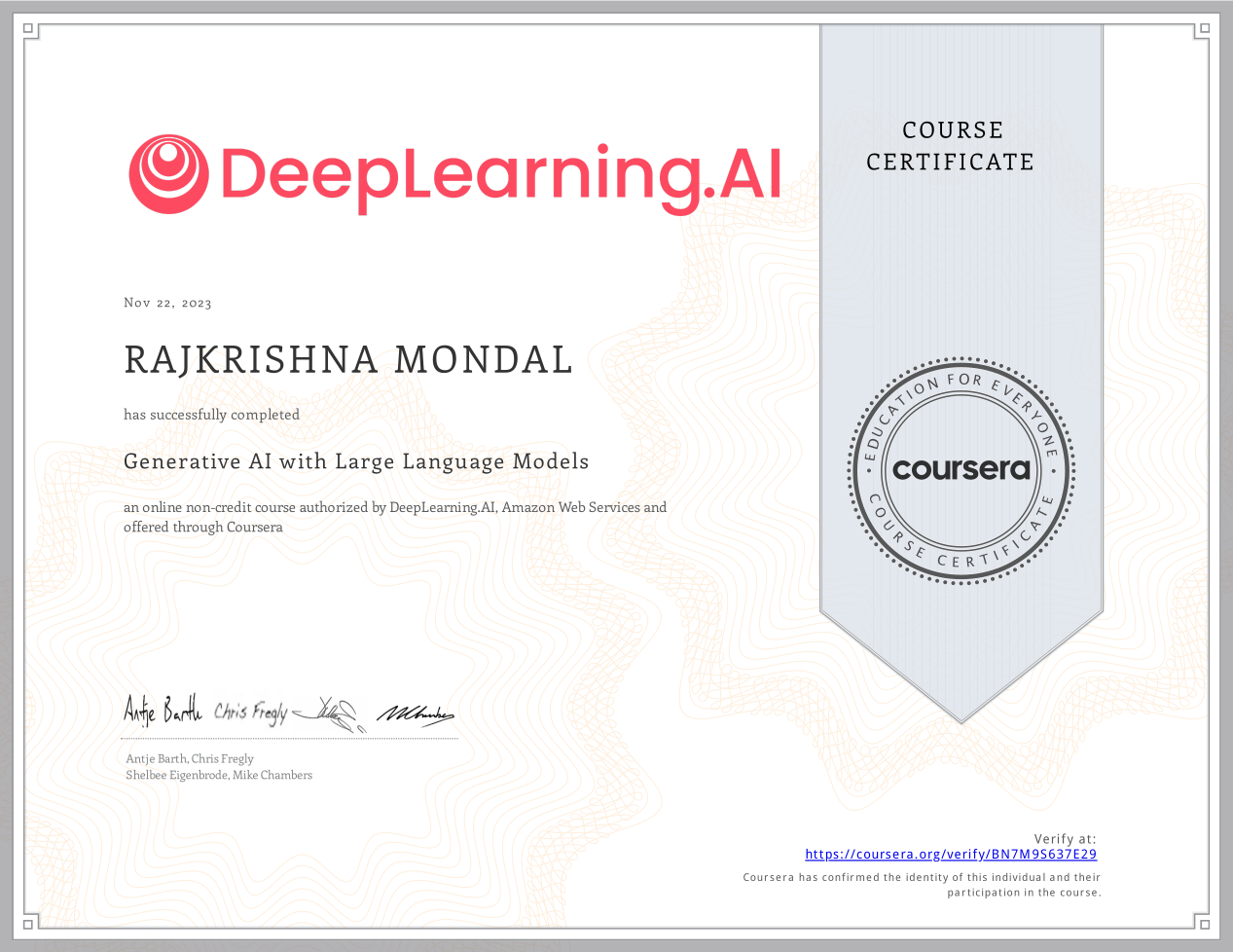
Generative AI with Large Language Models

November 22, 2023

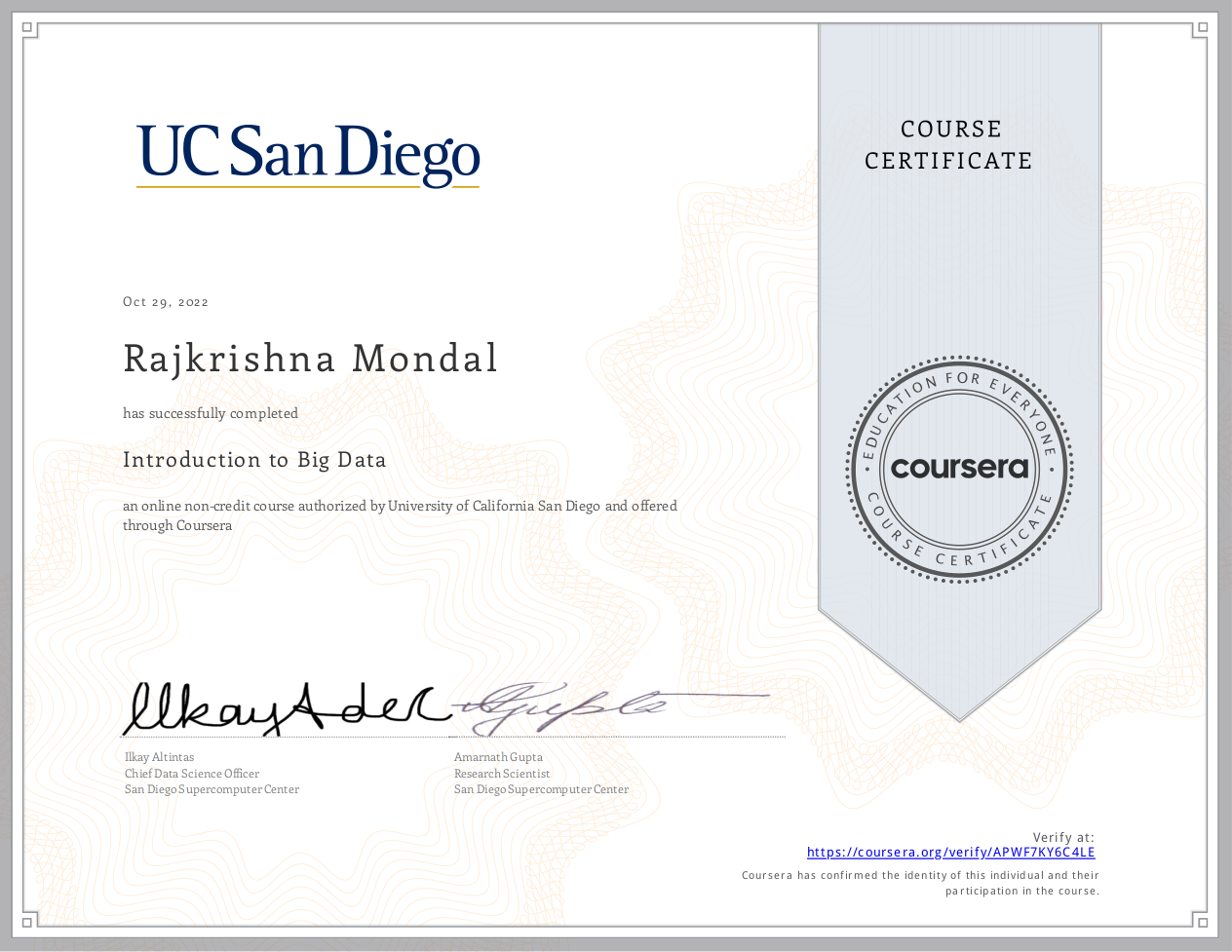
Introduction to Big Data

October 29, 2022

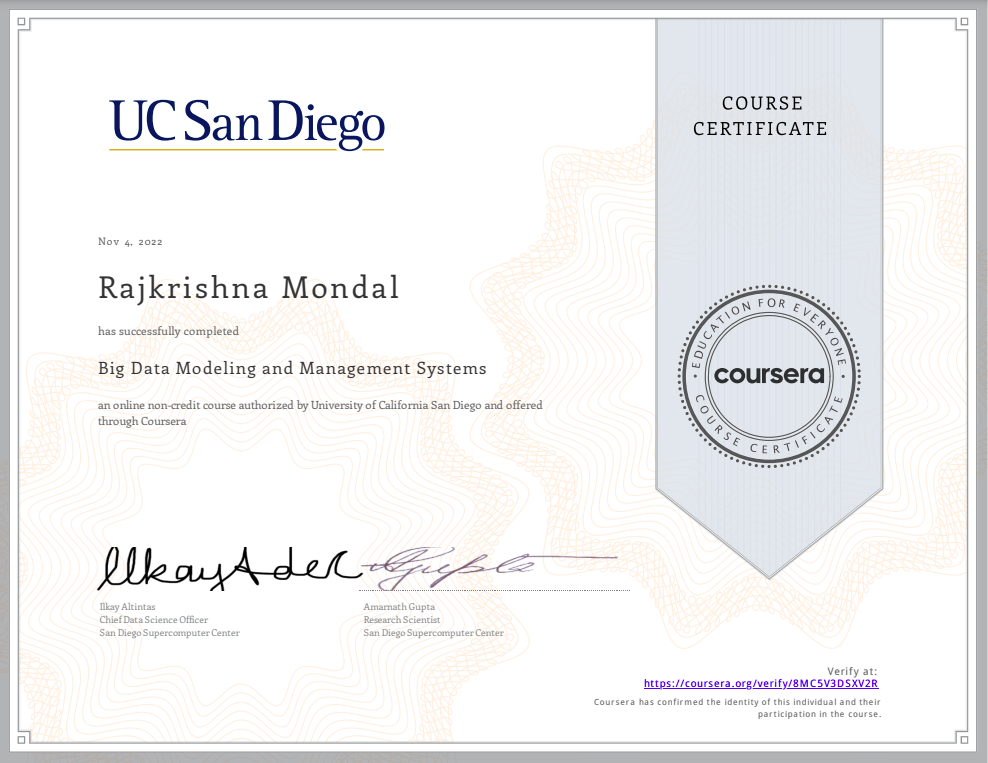
Big Data Modeling and Management Systems

November 7, 2022

Short Courses on Generative AI from DeepLearning.AI

Completed multiple short courses on Generative AI from DeepLearning.AI, covering LangChain, Retrieval-Augmented Generation (RAG), fine-tuning LLMs, semantic search, agentic workflows, and multi-agent systems. Specialized in building AI applications, database agents, and serverless AI workflows using LlamaIndex, Chroma, and Amazon Bedrock.

LangChain for LLM Application Development

What I learned

  • The LangChain component model (prompts, parsers, memories, chains, retrievers, and agents) and how they compose into production pipelines.
  • Hands-on code examples for stateful conversations: session memory, serialization, and state updates across turns.
  • How to build, evaluate, and iterate chains and QA modules (including evaluation checkpoints and test prompts).
  • Practical agent patterns (planner/actor, tool calling) and when to use agents vs. simple chains.

How this helps industry / improves business

  • Accelerates building maintainable LLM apps using modular components → reduces development time and technical debt.
  • Improves customer experience with context-aware conversations (memory + chained reasoning) → better retention & NPS.
  • Easier testing and evaluation lowers risk when shipping assistants that touch customers or internal systems.
  • Clear agent patterns let businesses safely integrate LLMs with operational tooling (APIs, DBs).
View certificate / course

LangChain Chat with Your Data

What I learned

  • End-to-end RAG pipeline: document ingestion, chunking/splitting, embedding generation, and vectorstore usage.
  • How to wire retrieval into a chat loop (retriever → context assembly → generation) with code examples.
  • Vectorstore selection, embedding choices, and pragmatic retrieval tuning (window sizes, chunk overlap).
  • Logging and evaluation approaches for retrieval + generation quality.

How this helps industry / improves business

  • Converts internal docs into an interactive knowledge assistant — reduces search time for employees and customers.
  • Improves support & onboarding efficiency by surfacing exact doc passages as evidence.
  • Lowers cost of human research/triage by resolving common queries automatically.
  • Scales knowledge access across teams without heavy custom search engineering.
View certificate / course

Finetuning Large Language Models

What I learned

  • Decision framework: when to finetune vs. rely on prompting or retrieval.
  • Data-prep best practices (instruction format, label quality, dataset splits) and instruction-tuning basics.
  • Training loop considerations: hyperparameters, checkpointing, and evaluation metrics for specialized tasks.
  • Post-finetune evaluation and safety checks (bias/hallucination monitoring).

How this helps industry / improves business

  • Produces domain-specific models with higher factual accuracy for vertical tasks (legal, finance, med).
  • Reduces manual editing and post-processing by baking domain rules into model behavior.
  • Enables product differentiation — companies can offer proprietary, fine-tuned assistants.
  • Improves compliance and auditability when models are tuned and validated to domain standards.
View certificate / course

Large Language Models with Semantic Search

What I learned

  • How to pair embeddings/dense retrieval with reranking to build semantic search.
  • Techniques for combining dense and sparse signals and for reranker integration.
  • Practical evaluation of retrieval quality and pipelines.

How this helps industry / improves business

  • Delivers more relevant search results across product docs, support articles, and knowledge bases.
  • Increases self-service effectiveness (fewer escalations) and improves discovery in large content stores.
  • Better customer experiences via context-aware search that understands intent rather than keywords.
View certificate / course

Building Systems with the ChatGPT API

What I learned

  • Composing chained API calls, integrating Python code, and automating chat workflows.
  • Building chat-based automations for use cases like customer service and internal tooling.

How this helps industry / improves business

  • Automates routine support and internal workflows (ticket triage, first-pass responses).
  • Enables fast prototyping of assistant features that integrate with existing backend systems.
View certificate / course

Functions, Tools and Agents with LangChain

What I learned

  • Function-calling patterns and LangChain Expression Language (LCEL) for composing tool-enabled agents.
  • Techniques for safe tool routing and extracting structured outputs from LLMs to drive external APIs.
  • How to design agent/tool interfaces, tag inputs/outputs, and manage fallbacks.
  • How to test and monitor tool-invoking agents in controlled environments.

How this helps industry / improves business

  • Lets assistants perform real actions (DB writes, API calls) from natural language while keeping audit trails.
  • Automates operational workflows (ordering, ticketing, scheduling) with less manual integration code.
  • Improves reliability by separating reasoning from tool execution (clear boundaries + retries).
  • Enables richer product features (e.g., in-app actions) improving conversion/engagement.
View certificate / course

Building and Evaluating Advanced RAG

What I learned

  • Advanced retrieval strategies: sentence-window retrieval, chunk merging, and hybrid retrieval patterns.
  • Evaluation methodologies for RAG: evidence coverage, retrieval precision, and generation faithfulness.
  • Techniques for pipeline orchestration and trade-offs (latency vs. evidence breadth).
  • How to set up A/B and offline tests to compare retrieval approaches.

How this helps industry / improves business

  • Produces more trustworthy answers (with cited evidence) — critical for support, legal, and regulated domains.
  • Improves end-user satisfaction by reducing hallucinations and giving sourceable responses.
  • Better metric-driven iteration reduces costs (fewer tokens wasted, fewer escalations).
  • Helps ops teams choose retrieval-stack trade-offs aligned to product SLAs.
View certificate / course

Advanced Retrieval for AI with Chroma

What I learned

  • Practical Chroma usage: index construction, embedding adapters, and query-time tuning.
  • How to couple Chroma with rerankers (cross-encoder) and query expansion strategies.
  • Diagnostics: when embeddings fail and how to fix failure modes with adapter or hybrid approaches.
  • Best practices for scaling and maintaining vector indices.

How this helps industry / improves business

  • Raises retrieval precision across large content stores — improving relevance for product search and support.
  • Lowers false positives through reranking, reducing time wasted by users and support staff.
  • Helps engineering teams scale vector infra efficiently and control costs.
  • Enables quick experimentation with different embedding models/adapters to optimize ROI.
View certificate / course

Knowledge Graphs for RAG

What I learned

  • How to extract schemas and entities, and construct graph representations (Neo4j / Cypher examples).
  • Techniques to align knowledge graphs with embeddings for hybrid retrieval.
  • Using graphs to add symbolic context for agent planning and multi-hop queries.
  • Practical graph-building pipelines and maintenance tips.

How this helps industry / improves business

  • Enables explainable reasoning (entity relationships) — important for compliance and analytics.
  • Improves multi-step and compound query resolution by agents (cross-document linking).
  • Supports dashboards and analytics over entities/relations — valuable for BI and product teams.
  • Enhances agent planning by providing structured knowledge for decision-making.
View certificate / course

Preprocessing Unstructured Data for LLM Applications

What I learned

  • End-to-end doc pipelines: OCR/text extraction, cleaning, normalization, chunking, and metadata enrichment.
  • File-type specifics (PDFs, PPTs, HTML): handling layout, extracting semantic sections, and preserving provenance.
  • Chunking strategies (size, overlap) to balance context fidelity and retrieval performance.
  • How to instrument ingestion for traceability and downstream debugging.

How this helps industry / improves business

  • Higher-quality inputs reduce hallucinations and increase retrieval precision for production systems.
  • Faster onboarding of new data sources (contracts, invoices) into knowledge stores and analytics.
  • Reduces manual preprocessing effort, lowering labor costs and time-to-insight.
  • Improves audit trails which are important in regulated workflows (finance, healthcare).
View certificate / course

Building Agentic RAG with LlamaIndex

What I learned

  • How to use LlamaIndex to create agentic retrieval pipelines: indexing, query planning, and tool integration.
  • Architectures for planner/actor workflows, multi-step decomposition, and integration of external tools.
  • Evaluating agentic behavior across multi-document reasoning tasks.
  • Practical integration patterns for LlamaIndex with vector stores and LLMs.

How this helps industry / improves business

  • Enables autonomous multi-step assistants for tasks like contract review, research synthesis, and audits.
  • Reduces manual triage by automating structured multi-document analysis.
  • Lets companies deploy intelligent workflows that combine retrieval + programmatic actions.
  • Faster productization of complex agent features (e.g., multi-document summarizers).
View certificate / course

Building Your Own Database Agent

What I learned

  • Connectors and safe prompt templates to translate natural-language queries into SQL and interpret results.
  • Techniques to validate and sanitize generated SQL and to present results safely.
  • Patterns for incremental query-building, aggregation, and returning explainable results.
  • How to design UX that shows provenance and confidence for query outputs.

How this helps industry / improves business

  • Empowers non-technical staff to query data directly, reducing analyst bottlenecks.
  • Speeds exploratory data analysis and reporting — faster decision cycles.
  • Reduces errors by applying validation/sanitization before executing generated SQL.
  • Offers product features for analytics platforms (natural-language BI).
View certificate / course

Serverless Agentic Workflows with Amazon Bedrock

What I learned

  • How to deploy serverless LLM apps via Amazon Bedrock and integrate them with agents, tools, and event triggers.
  • Guardrail patterns and monitoring approaches for production agentic workflows on cloud infrastructure.
  • Cost & scaling considerations when running agentic workloads serverlessly.
  • Practical orchestration: how to connect toolchains and function execution to LLM decision points.

How this helps industry / improves business

  • Rapidly ships scalable LLM apps with less infra overhead (managed Bedrock services).
  • Simplifies compliance (cloud provider monitoring/guardrails) for enterprises.
  • Enables cost-effective scale-up via serverless pricing models for intermittent agent workloads.
  • Shortens time-to-market for enterprise-grade assistant features.
View certificate / course

Multi AI Agent Systems with crewAI

What I learned

  • Designing multi-agent teams, assigning roles, and orchestrating inter-agent communications.
  • Coordination patterns (delegation, aggregation, and conflict resolution) and evaluation techniques.
  • How to decompose big tasks into specialized agents for reliability and parallelism.
  • Monitoring and logging strategies for multi-agent orchestration.

How this helps industry / improves business

  • Enables complex, long-horizon workflows (project planning, multi-step customer journeys) to be automated.
  • Improves throughput and accuracy by specialization and parallelization.
  • Reduces single-agent failure modes by distributing responsibilities.
  • Provides a framework for productizing orchestration as a service.
View certificate / course

Practical Multi AI Agents and Advanced Use Cases with crewAI

What I learned

  • Case studies: project planning, content pipelines, and customer support orchestration using multi-agent systems.
  • Evaluation metrics and frameworks for multi-agent performance and coordination.
  • Deployment considerations for real-world multi-agent products.
  • Fail-safe and fallback mechanisms for complex agent networks.

How this helps industry / improves business

  • Rapid prototyping of multi-agent products that can be turned into commercial features.
  • Better decomposition of workflows reduces time and cost per task, improving margins.
  • Provides templates for scaling agent workloads across customers and domains.
  • Improves reliability of multi-step service automation (less human intervention).
View certificate / course

Reasoning with o1

What I learned

  • Techniques for eliciting structured reasoning from advanced models (prompt scaffolding, chain-of-thought).
  • How to frame complex tasks (planning, multi-step reasoning) to get higher-quality outputs.
  • Practical examples showing improved accuracy with reasoning prompts and structured inputs.
  • Approaches to verify and audit model reasoning.

How this helps industry / improves business

  • Boosts model reliability on complex decision-support tasks (risk, policy, technical analysis).
  • Reduces expert time by providing high-quality first drafts for review.
  • Supports building explainable systems where chain-of-thought aids human reviewers.
  • Useful for internal knowledge workers and high-value consulting workflows.
View certificate / course

Long-Term Agentic Memory with LangGraph

What I learned

  • Building long-term memory systems (semantic, episodic, procedural) with LangGraph and memory stores.
  • Implementing memory-based agents: storing/retrieving facts, preferences, and system prompts.
  • Practical use-case: building an email assistant that routes, drafts, and schedules with memory-aware behavior.
  • How to design searchable memory schemas and privacy-sensitive storage.

How this helps industry / improves business

  • Improves personalization (remembering user preferences) and reduces repetitive user input.
  • Enhances productivity tools (email assistants, CRMs) by maintaining context across long interactions.
  • Raises retention for B2C agents by delivering consistent, personalized experiences.
  • Facilitates compliance-aware memory strategies for enterprise deployments.
View certificate / course

MCP: Build Rich‑Context AI Apps with Anthropic

What I learned

  • Model Context Protocol (MCP) fundamentals: tools, resources, prompts, and transports (STDIO, HTTP+SSE).
  • How to build a local MCP server, expose tools and resources, and connect clients (e.g., Claude).
  • How to use MCP to surface files, web fetches, and system tools into the model’s context.
  • Debugging and testing workflows for MCP integrations.

How this helps industry / improves business

  • Standardizes how LLM apps access external tools and data — easier cross-team integrations.
  • Enables safer and richer LLM apps that can fetch and reason over live resources (files, web).
  • Reduces engineering friction when connecting LLMs to enterprise infrastructure.
  • Provides a modular architecture for building enterprise assistants with tool access.
View certificate / course

Agentic Knowledge Graph Construction

What I learned

  • Multi-agent pipelines to extract schema proposals, suggest file groupings, and iteratively build vector/graph artifacts.
  • Practical code walkthroughs for constructing knowledge graphs from unstructured inputs.
  • Techniques for combining vector and graph representations and incremental graph population.
  • Evaluation and monitoring strategies for graph quality.

How this helps industry / improves business

  • Produces structured world models that improve agent planning and cross-document retrieval.
  • Makes entity relationships queryable for analytics, compliance, and automation.
  • Improves long-term maintainability of knowledge assets used by agentic products.
  • Speeds up integration of legacy doc estates into modern AI pipelines.
View certificate / course

MCP: Build AI Apps with MCP Server — Working with Box Files

What I learned

  • Integrating Box as a data source via MCP: discovering files, extracting text, and building pipelines for document workflows (invoices, contracts).
  • Converting single-agent flows into multi-agent A2A architectures for better scaling and role separation.
  • How to handle file access, authentication, and streaming transports.
  • Tools and prompts to map file contents into structured outputs for downstream agents.

How this helps industry / improves business

  • Automates document-heavy processes by connecting cloud storage to agentic pipelines (fast invoice/contract extraction).
  • Reduces manual data entry and speeds document-centric workflows (legal, procurement).
  • Makes enterprise document automation more secure and auditable by leveraging provider auth and MCP transport patterns.
  • Enables rapid prototyping of cloud-backed agentic services.
View certificate / course

Knowledge Graphs for AI Agent: API Discovery

What I learned

  • Constructing a knowledge graph for AI agents, enabling them to discover, represent, and traverse API relationships.
  • How to integrate agents with APIs by mapping between structured API schemas and unstructured user intents.
  • Techniques for embedding, search, and vector databases to support agent context and retrieval.
  • Orchestrating API sequences through the knowledge graph to satisfy complex user requests reliably.

How this helps industry / improves business

  • Allows AI agents to dynamically discover and call APIs without hard-coding logic.
  • Enhances flexibility in automating domain workflows by linking services via graph structure.
  • Improves robustness and maintainability, especially when new APIs or endpoints are added or changed.
  • Speeds prototyping of intelligent agent systems that can adapt to changing APIs and capabilities.
View certificate / course

Building Live Voice Agents with Google’s ADK

What I learned

  • How to build real-time voice AI agents using Google's Agent Development Kit (ADK) and the Gemini Live model.
  • Designing and orchestrating multi-agent systems (e.g., planners, researchers, writers) that collaborate on complex tasks.
  • Utilizing ADK primitives: Session, State, and Memory for managing conversational flow, short-term tracking, and long-term recall.
  • Integrating agents with external capabilities using Tools (like Google Search) and APIs to perform real-world actions.
  • Implementing guardrails and instruction tuning to constrain, secure, and control agent behavior for reliable performance.
  • Methods for productionizing agents, including deployment on Google Cloud’s Vertex AI Agent Engine.

How this helps industry / improves business

  • Enables the creation of human-like, real-time conversational AI applications that can handle voice input and output.
  • Allows for the development of complex, multi-functional agentic systems that can decompose and execute multi-step workflows.
  • Provides a scalable, robust, and open-source framework (ADK) for building and maintaining production-ready voice agents.
  • Speeds up the integration of advanced voice capabilities into existing AI products for richer, more natural user interactions.
View certificate / course

Work Experience

A journey of innovation, leadership, and expertise in AI, Data Science, and NLP-driven solutions.

Senior Prompt Engineer

Accrete AI

June 9, 2025 – Present

As a Senior Prompt Engineer at Accrete AI, I lead the design, instruction-tuning, and operationalization of high-impact prompts and prompt libraries for Accrete’s Expert AI Agents and Knowledge Engines. I build robust prompt templates, evaluation suites, and tooling that improve accuracy, grounding, and reliability of agentic workflows used by both enterprise and government customers.

Key Responsibilities & Contributions:

🔹 Prompt Engineering & Instruction Tuning
  • Design, iterate, and optimize complex prompt chains, system instructions, and few-shot templates to improve agent reasoning and task reliability.
  • Implement instruction-tuning experiments and evaluate model behavior across retrieval-augmented, chain-of-thought, and agentic patterns.
  • Build reusable prompt libraries and guardrails for domain-specific Knowledge Engines to ensure grounding in verified sources and auditability.
🔹 Agent & Platform Integration
  • Integrate prompts with Accrete’s Agent frameworks (Expert AI Agents / Knowledge Engines) to power automated analytic workflows and persistent memory.
  • Develop end-to-end agent pipelines using LangChain-style orchestration, retrieval (RAG) connectors, and vector stores for grounded responses.
  • Prototype and productionize agent behaviors that generate reports, perform triage, extract entities, and translate NL → SQL for non-technical stakeholders.
🔹 Productionization & Infrastructure
  • Own prompt deployment patterns and CI/CD for model prompts, including A/B experiments, telemetry, and regression tests to catch prompt drift.
  • Collaborate with platform and SRE teams on server deployment, secure API endpoints (FastAPI), MCP-compatible context management, and scalable host infra.
  • Ensure compliance, logging, and evaluation tooling for high-assurance environments used by enterprise and government customers.
🔹 Research, Mentorship & Cross-functional Collaboration
  • Run applied research into prompt methods, evaluation metrics, and model alignment; turn findings into pragmatic playbooks for product teams.
  • Mentor prompt engineers and data scientists, evangelize best practices for prompt design, and lead prompt review sessions across product squads.
  • Work closely with product, legal, and customer-facing teams to tailor agent behavior for domain constraints and user needs.

Impact & Achievements:

🚀 Operational & Product Impact
  • Improved agent answer relevance and grounding by implementing structured prompt templates and RAG practices, increasing downstream task accuracy.
  • Reduced time-to-insight for analysts by integrating prompt-driven automation into knowledge-engine workflows and Argus-style monitoring use cases.
🏆 Recognition & Outcomes
  • Enabled production-ready Expert AI Agent behaviors that support enterprise/government workflows, improving decision speed and auditability.
  • Built reproducible prompt testing infrastructure and prompt libraries now used across multiple product teams.

At Accrete AI I translate domain expertise into robust prompt-driven behaviors that power Expert AI Agents and Knowledge Engines, driving reliable automation, improved analyst productivity, and mission-critical decision support.

Data Scientist (Project Lead Developer)

Infinite Analytics Pvt. Ltd., Mumbai

September 26, 2021 – May 11, 2025

Leading the design, development, and deployment of an AI-powered Cognitive Search Engine, I have transformed data interaction through advanced Natural Language Processing (NLP), Large Language Models (LLMs), and Agent-Based Workflows. My work has significantly enhanced business intelligence, decision-making, and automation, making a lasting impact on operational efficiency.

Key Responsibilities & Contributions:

🔹 Technical Vision & System Architecture
  • Designed and implemented a robust AI-driven cognitive search engine integrating LLMs, NLP, and agent-based workflows.
  • Developed core modules including natural language query processing, document ingestion, entity extraction, and automated SQL generation.
  • Utilized LangChain and LangGraph to build seamless AI-driven data retrieval pipelines.
  • Architected a scalable, cloud-based AI platform ensuring security, efficiency, and maintainability.
🔹 AI Development & Integration
  • Integrated LLMs (OpenAI, Ollama) with vector stores like Chroma and agent frameworks.
  • Built pipelines for processing unstructured data using document loaders, text splitters, and memory management techniques.
  • Developed NLP-driven intelligent search capabilities, enabling seamless query handling and accurate response generation.
  • Automated workflows such as:
    • Natural Language to SQL Translation – Enabling non-technical users to query databases effortlessly.
    • AI-powered Report Generation – Reducing manual workload by automating insights extraction.
    • API Interfacing with FastAPI – Creating scalable and efficient API endpoints for seamless integration.
🔹 Team Leadership & Project Management
  • Led a multi-disciplinary team of developers, data scientists, and engineers in building AI-powered solutions.
  • Mentored junior developers and provided hands-on training in AI model deployment, NLP, and big data technologies.
  • Ensured project milestones were met on time and within budget, using Agile methodologies for efficient task management.
🔹 Quality Assurance & Deployment
  • Implemented robust coding standards, rigorous testing frameworks, and CI/CD pipelines.
  • Optimized AI models for performance, scalability, and real-time processing.
  • Ensured data security and compliance in AI-driven applications.

Impact & Achievements:

🚀 Business Transformation & Growth
  • Empowered the organization with faster and more accurate data retrieval, enhancing business decision-making across all departments.
  • Reduced manual data processing time by 70% through automated AI-powered workflows.
  • Enabled data-driven insights that facilitated revenue growth and optimized marketing & sales strategies.
📈 Customer Experience & AI-Powered Assistance
  • Developed an AI-powered chatbot for real-time customer support, reducing response time and increasing user satisfaction.
  • Enhanced customer personalization by leveraging AI to predict user needs and offer tailored recommendations.
💡 Competitive Advantage & AI-Driven Innovation
  • Integrated cutting-edge Generative AI & NLP models, providing the company with a technological edge in the market.
  • Implemented intelligent automation, improving productivity and reducing operational costs.
  • Strengthened data-driven decision-making, enabling the company to make more strategic moves with real-time insights.
🏆 Recognitions & Success
  • Played a pivotal role in achieving company-wide AI adoption, making data more accessible and actionable.
  • Successfully deployed AI solutions that enhanced user engagement, increased retention rates, and boosted operational efficiency.

By integrating this advanced AI solution, I have helped Infinity Analytics Pvt. Ltd. gain a competitive advantage through intelligent automation, AI-driven decision-making, and improved customer engagement. The impact of my contributions continues to drive innovation and efficiency, positioning the company at the forefront of AI-powered business intelligence.

Academic Board Member

Learnbay, a distinguished college within Woolf University

September 9, 2023 – Present

As an Academic Board Member at Learnbay, a distinguished college within Woolf University, I have undertaken a multifaceted role dedicated to upholding and enhancing the institution's academic excellence.

My key responsibilities and contributions include:

  • Strategic Academic Planning: Collaborated with fellow board members to develop and refine the academic mission and strategic goals of Learnbay, ensuring alignment with Woolf University's overarching objectives.
  • Curriculum Oversight: Evaluated and approved comprehensive degree programs and industry-specific certifications, emphasizing a 'learn by doing' philosophy that integrates theoretical knowledge with practical application.
  • Quality Assurance: Established rigorous academic policies and standards to maintain educational quality and integrity, contributing to the formulation and implementation of policies related to teaching, learning, assessment, and research.
  • Faculty Development: Participated in the recruitment, evaluation, and promotion processes of faculty members, fostering an environment conducive to academic excellence and innovation.
  • Regulatory Compliance: Ensured that Learnbay's programs and practices adhere to relevant educational regulations and accreditation standards, providing guidance on compliance matters.
  • Student Success Initiatives: Advocated for and implemented policies aimed at enhancing student support services, progression, and overall success, including the integration of real-world projects certified by industry and globally recognized universities.
  • Institutional Advancement: Advised on strategic partnerships and collaborations to expand Learnbay's global presence, contributing to the institution's mission of delivering world-class education.

Through these efforts, I have played a pivotal role in shaping Learnbay's academic landscape, ensuring the delivery of high-quality education that meets the evolving needs of students and the global industry.

I.T. Advisory Committee Member

FATER Academy of India

January 1, 2018 – September 24, 2021

Served as a key member of the IT Advisory Committee, contributing significantly to the academy’s IT strategies and operations. In this role, I helped shape the institution’s technology initiatives through hands-on web development, robust data management, clear documentation practices, and strategic IT contributions.

Key Responsibilities & Contributions:

🔹 Web Development
  • Developed and maintained the academy's website to ensure a user-friendly and up-to-date online presence.
🔹 Data Management
  • Handled the organization, storage, and security of data, ensuring efficient and secure data management systems.
🔹 Documentation
  • Led documentation processes for IT projects, ensuring all records were clear, well-organized, and easily accessible for future reference.
🔹 IT-Related Strategic Initiatives
  • Contributed to various IT functions and provided strategic input for ongoing technological improvements.

Recognized for excellent technical skills, proactive problem-solving, and the ability to work effectively both independently and as part of a team, my contributions greatly enhanced the academy’s IT operations.

Services

Leverage advanced AI, NLP, and data science techniques to accelerate your business objectives. My services are designed to optimize operations, drive innovation, and deliver actionable insights for sustainable growth.

Prompt Engineering

Crafting precise and impactful prompts for large language models to enhance content generation, automate workflows, and drive efficient communication that improves customer interactions.

Artificial Intelligence

Developing tailored AI solutions that automate processes, enhance customer experiences, and generate innovative strategies—empowering your business to stay ahead in a competitive market.

Natural Language Processing

Utilizing advanced NLP techniques to analyze and interpret textual data, enabling you to extract actionable insights from customer feedback, market trends, and operational reports.

Mathematical Modelling

Applying robust mathematical models and statistical methods to forecast trends, optimize resources, and underpin strategic decision-making with quantitative accuracy.

Decision Science

Transforming complex data sets into clear, strategic insights. Enable smarter decisions that reduce risks and open up new revenue streams through actionable, data-driven strategies.

Qualitative Research

Conducting deep-dive qualitative analyses to understand consumer behavior and market dynamics, providing nuanced insights that inform and elevate your strategic planning.

Complex Decision Making

Utilizing sophisticated models to address multifaceted challenges. I provide clear, data-backed recommendations to navigate uncertainties and achieve consistent business growth.

Soft Computing

Leveraging fuzzy logic and neural networks to create adaptive systems that process imprecise data, enhancing predictive accuracy and enabling agile, innovative decision-making.

Agent-Based System Automation

Deploying advanced LLMs to build intelligent, autonomous agents that automate workflows, integrate seamlessly with your existing systems, and streamline business processes for optimal efficiency.

How I can help you to increase your Revenue?

With a deep expertise in Artificial Intelligence, Data Science, and advanced algorithm development, I can drive transformative change in your business. My experience in designing AI-powered solutions—ranging from cognitive search engines to automated data pipelines—enables me to streamline operations, enhance decision-making, and uncover new revenue opportunities.

Enhancing Business Operations
  • Intelligent Data Retrieval: Implement AI-powered cognitive search engines that make data more accessible and actionable, speeding up decision-making processes.
  • Process Automation: Automate routine tasks such as data extraction, report generation, and SQL query formulation to reduce manual effort and operational costs.
  • Data-Driven Insights: Utilize advanced analytics and NLP to derive meaningful insights from complex datasets, helping you to optimize processes and improve efficiency.
Driving Revenue Growth
  • Customer Insights & Personalization: Leverage generative AI and NLP techniques to analyze customer behavior, enabling targeted marketing strategies and personalized customer experiences.
  • Innovation & Competitive Edge: Integrate cutting-edge AI components such as large language models and agent frameworks to foster innovation, differentiate your offerings, and capture emerging revenue streams.
  • Scalable and Secure Solutions: Design robust system architectures that ensure scalability and secure deployment, positioning your business for sustainable long-term growth.

By combining these strategies with my proven leadership in managing multidisciplinary teams and complex projects, I can help your business not only streamline operations but also drive significant revenue growth and maintain a competitive advantage in today’s dynamic market.

Let’s work together to unlock your business’s full potential.

Ready to transform your business with cutting-edge AI and data science solutions?

Let’s collaborate to unlock new growth opportunities and achieve your strategic objectives.

Get In Touch

Testimonials

Hear from our partners and clients about the transformative impact of our AI solutions.


Rajkrishna's AI-powered solutions transformed our business operations. His leadership in developing a cognitive search engine enabled us to access actionable insights quickly, leading to significant revenue growth.

Rajesh Kumar

CEO & Founder


The innovative approach to automating data extraction and report generation saved us countless hours and drastically reduced our operational costs.

Anita Deshmukh

Lead Data Scientist


Rajkrishna's expertise in generative AI and NLP is unparalleled. His solutions not only streamlined our data processes but also provided deep insights that unlocked new revenue streams.

Vikram Singh

Chief Technology Officer


Working with Rajkrishna was a turning point. His ability to extract actionable insights from complex datasets revolutionized our strategic planning and boosted our growth.

Priya Sharma

Operations Manager


His strategic vision in integrating advanced AI components revolutionized our marketing efforts, ensuring timely insights and a competitive edge in the marketplace.

Suresh Reddy

Marketing Head

Contact

Get in touch for collaborations, consultations, or inquiries.

Address

Vill-Patharghata, Post- Dakshin Dauki, Police Station- Contai(Junput Coastal), Dist- Purba Medinipur, West Bengal-721450, India.